
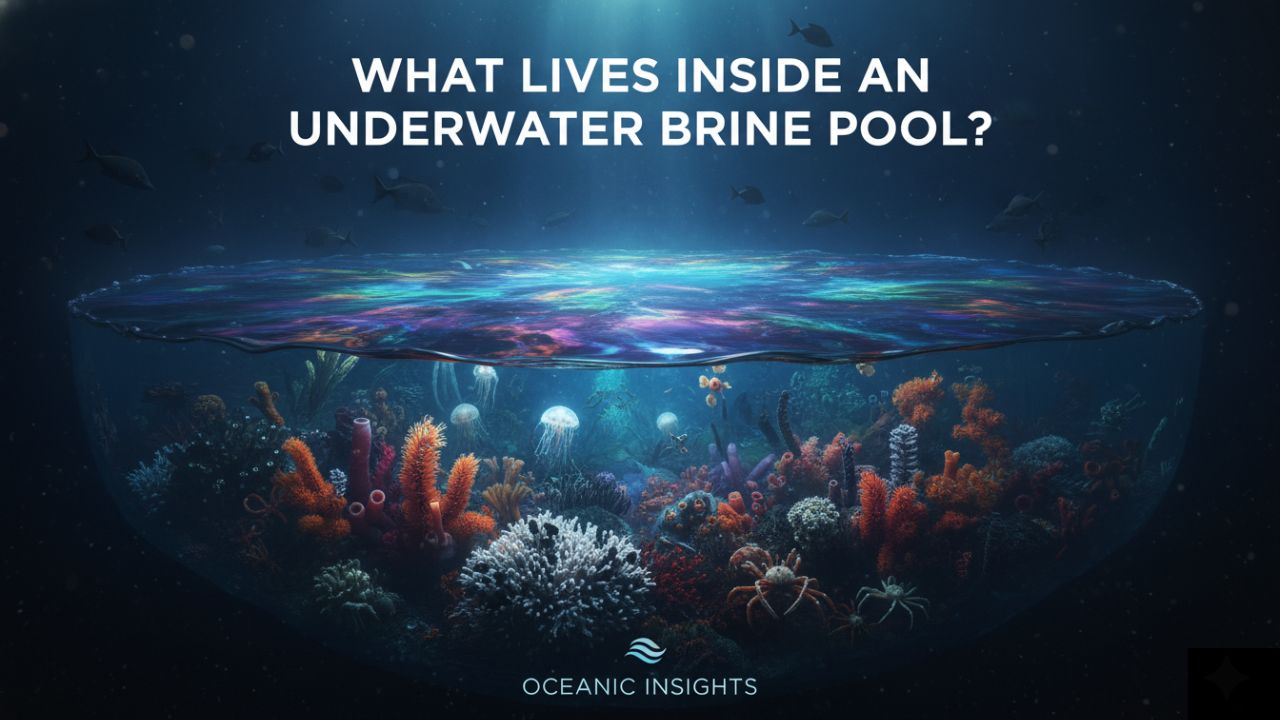
Deep beneath the ocean’s surface, in the perpetual darkness of the deep sea, lies one of Earth’s most paradoxical environments. When submersibles descend thousands of feet below the waves, they occasionally encounter what appears to be a body of water resting on the seafloor a lake beneath the sea. These are underwater brine pools, and the question of what lives inside an underwater brine pool reveals a fascinating story of life thriving at the absolute edge of survival.
These strange underwater lakes, sometimes called “hot tubs of despair” or “jacuzzis of death,” represent some of the most extreme environments on our planet. Yet despite their deadly nature, underwater brine pools support surprising ecosystems that challenge our understanding of where life can exist. They are simultaneously death traps and oases of biological activity, depending on where you look within their toxic depths.
What Are Underwater Brine Pools?
Before exploring what lives inside an underwater brine pool, we need to understand what these remarkable features actually are and how they form. An underwater brine pool occurs when extremely salty water typically three to eight times saltier than the surrounding seawater collects in a depression on the ocean floor. This hypersaline solution is so dense that it refuses to mix with the ocean above it, creating what looks like a separate body of water complete with a distinct surface, shoreline, and even waves.
The formation process varies by location, but many underwater brine pools share similar origins. In the Gulf of Mexico, which hosts some of the largest known brine pools, the story begins approximately 150 million years ago during the Jurassic period. At that time, the Gulf was a shallow sea that periodically dried out, leaving behind massive salt deposits up to 8 kilometers thick in some areas.
As the Gulf reconnected to other oceans and filled with seawater, these ancient salt layers became buried under accumulating sediment. Over millions of years, geological forces squeezed and shaped these buried salt formations. The salt, being less dense than the rock above it, began to rise upward through the overlying sediment in a process geologists call salt tectonics. When seawater infiltrates these rising salt domes through cracks and fissures, it dissolves the salt into a concentrated brine solution that eventually seeps onto the seafloor.
Because this brine solution is significantly denser than regular seawater often with a density 1.2 to 1.3 times greater it behaves almost like a separate liquid. The brine pools on the ocean bottom, creating a visible boundary layer called a halocline that separates the hypersaline water from the normal seawater above. This interface looks remarkably similar to the surface of a terrestrial lake and even forms ripples and waves when disturbed by passing submersibles or underwater currents.
The Deadly Chemistry of Brine Pools
To truly understand what lives inside an underwater brine pool, we must first appreciate the extreme hostility of these environments. The underwater brine pool is toxic to most marine life for several interconnected reasons, each more challenging than the last.
Extreme Salinity: The salt concentration in these pools is staggering. While seawater typically contains about 35 grams of salt per liter, underwater brine pool concentrations can reach 150 to 280 grams per liter roughly four to eight times saltier than the ocean. For comparison, this is saltier than the Dead Sea.
Oxygen Depletion: Most underwater brine pools contain almost no dissolved oxygen. The lack of mixing between the dense brine and the water above means oxygen cannot diffuse into the pool. Animals that require oxygen to breathe which includes most marine life cannot survive more than minutes in this anoxic environment.
Toxic Chemicals: Many underwater brine pools contain high concentrations of methane and hydrogen sulfide, compounds that are poisonous to most complex life forms. These chemicals seep from the seafloor along with the brine, creating a deadly cocktail. Hydrogen sulfide, which smells like rotten eggs, is toxic even in small concentrations.
Osmotic Shock: When a fish or crab enters an underwater brine pool, the dramatic difference in salt concentration between their body fluids and the surrounding water causes catastrophic cellular damage. Water rapidly exits their cells through osmosis, similar to what happens when you salt food to preserve it. This process, called osmotic shock, can kill an animal within minutes. Their bodies become “pickled” in the hypersaline water, often remaining preserved for decades.
Scientists studying these environments have observed eels, crabs, and fish that ventured too close to the brine and succumbed to its toxic effects. Their preserved remains litter the bottom of some pools, creating eerie underwater graveyards that serve as stark reminders of the brine’s deadly nature.
Life on the Edge: The Productive Margins
While the underwater brine pool interior is largely inhospitable, the shores of these underwater lakes tell a completely different story. The edges and transition zones support some of the most productive ecosystems in the entire deep ocean. When examining what lives inside an underwater brine pool ecosystem taking a broader view that includes the margins we discover a thriving community that rivals the biomass of coral reefs.
The foundation of life around an underwater brine pool consists of chemosynthetic bacteria and archaea. Unlike nearly all other life on Earth, which ultimately depends on sunlight and photosynthesis, these microscopic organisms derive their energy from chemical reactions. They process the methane and hydrogen sulfide seeping from the seafloor, converting these toxic compounds into organic matter through a process called chemosynthesis.
These microbes form the base of an entire food chain that exists in complete darkness, independent of the sun. Dense bacterial mats and biofilms develop along the brine pool interface, creating colorful layers often reddish, pinkish, or orange that carpet the transition zone between the deadly brine and the surrounding seawater.
The Remarkable Mussel Beds
Perhaps the most visually striking feature of underwater brine pool margins are the vast colonies of mussels that carpet the shores. These aren’t ordinary shellfish but highly specialized species that have evolved extraordinary adaptations to thrive in this extreme environment. Research has documented mussel densities exceeding 2,250 individuals per square meter, with beds ranging from 3 to 7 meters thick around some pools.
The primary mussel species found at Gulf of Mexico underwater brine pools is Bathymodiolus childressi, also called the methanotrophic or methane mussel. These remarkable creatures can grow to dinner-plate size, far larger than typical deep-sea shellfish, and they achieve their success through an intimate partnership with chemosynthetic bacteria.
Inside their gill tissues, these mussels harbor billions of bacterial symbionts that possess the extraordinary ability to metabolize methane. The bacteria essentially act as internal food factories, converting methane gas into nutrients that sustain the mussel. In return, the mussels offer the bacteria protection, a stable environment, and access to both methane from below and oxygen from the water column above.
This symbiotic relationship is so effective that it creates distinct zonation patterns in the mussel beds. The inner zone, positioned right at the edge of the underwater brine pool where methane concentrations are highest, provides optimal conditions for maximum growth. Mussels closer to the pool of brine are typically younger and shorter in shell length, but the abundant methane allows them to reach exceptional densities. The outer zone sits at the transition between the mussel bed and the surrounding seafloor, where lower methane availability results in mussels with lower densities and smaller maximum sizes.
The mussel beds themselves become habitats for other organisms. Small shrimp species like Alvinocaris stactophila shelter among the shells, while gastropods such as Bathynerita naticoidea graze on bacterial films coating the mussels. Polychaete worms, including the specially adapted Methanoaricia dendrobranciata (literally “methane-nymph with branched gills”), burrow through the mussel beds, taking advantage of the concentrated food resources.
Giant Tubeworms: Masters of Chemosynthesis
While tubeworms are more commonly associated with hydrothermal vents, certain species also colonize the margins of underwater brine pools and nearby cold seeps. These peculiar creatures primarily Lamellibrachia luymesi and Escarpia laminata in Gulf of Mexico environments look like something from science fiction, consisting of a protective tube with a bright red plume extending from the top.
What makes tubeworms particularly fascinating when examining what lives inside an underwater brine pool environment is that adult tubeworms have no mouth, no stomach, and no digestive system whatsoever. They literally cannot eat in the conventional sense. Instead, they possess a specialized internal organ called a trophosome that can comprise up to half their body weight. This trophosome is packed with billions of symbiotic bacteria so densely populated that the bacteria account for a significant portion of the worm’s weight.
The tubeworm’s brilliant red plume acts like a gill, absorbing both oxygen and hydrogen sulfide from the water. A specialized root-like structure burrows into the sediment, collecting additional hydrogen sulfide. The worm transports these substances to the trophosome, where the bacteria use them along with carbon dioxide to produce organic compounds through chemosynthesis. The worm receives all its nutrition from these bacterial partners, which in turn enjoy a protected environment with a reliable supply of the raw materials they need.
Research has revealed that some tubeworm species found at Gulf of Mexico cold seeps and underwater brine pool margins are among the oldest invertebrates known, potentially living for over 250 years. Their slow growth rates and remarkable longevity speak to the stability of these extreme environments once established. Scientists can measure their growth by staining living tubeworms with a colored dye, then recovering them months or years later to measure how much new tube material has been produced above the stained section.
Extremophilic Microbes: The True Inhabitants
When we examine what lives inside an underwater brine pool at the microscopic level specifically within the brine water itself rather than just at its margins we encounter organisms that push the boundaries of biology itself. These are the extremophiles, organisms that not only tolerate extreme conditions but actually require them to survive.
Halophilic Archaea: The dominant inhabitants of the brine itself are halophilic (salt-loving) archaea. These microscopic organisms belong to Archaea, one of life’s three domains, separate from both bacteria and eukaryotes. Unlike organisms that merely tolerate high salt, halophilic archaea are obligate halophiles they require extreme salt concentrations to survive and will actually die if exposed to normal seawater.
These archaea have evolved remarkable molecular adaptations. Some accumulate extraordinarily high concentrations of potassium ions in their cells up to 5 molar concentration to balance the external salt concentration. This adaptation requires their entire cellular machinery, including all their proteins and enzymes, to function at salt levels that would cause normal proteins to unfold and cease functioning.
The distinctive reddish or pinkish color often visible in the layers floating above an underwater brine pool comes from these halophilic archaea. The color derives from carotenoid pigments, similar to those that make carrots orange and tomatoes red. Scientists believe these pigments help protect the cells from radiation and oxidative stress in their extreme environment.
Specialized Bacteria: Beyond archaea, various species of highly adapted bacteria colonize different niches within the underwater brine pool ecosystem. Some bacteria can metabolize methane anaerobically (without oxygen), often working in partnership with archaea in the anoxic sediments through a process called anaerobic oxidation of methane. Others process hydrogen sulfide, nitrates, or other compounds, creating a complex network of chemical transformations.
Certain bacterial species found in underwater brine pools can even use perchlorate a highly toxic compound sometimes present in the brine as an electron acceptor to support growth. This remarkable ability has attracted attention from astrobiologists interested in the possibility of life on Mars, where perchlorate salts are common in the Martian soil.
The Methane Ice Worms
One of the most unusual discoveries related to underwater brine pool ecosystems is the ice worm Hesiocaeca methanicola, first described in 1997. These small segmented worms, typically 1 to 2 inches long, live in an environment almost as bizarre as the brine pools themselves: they burrow into methane hydrate ice.
At the low temperatures and high pressures found in the deep ocean, methane can form a crystalline solid structure with water molecules, creating what looks like orange or white ice. These methane hydrate deposits often occur near cold seeps and underwater brine pools where methane-rich fluids seep from the seafloor.
The ice worms excavate grooves and tunnels in this methane ice, and researchers have observed them in remarkable densities on some methane hydrate mounds. Scientists are still investigating exactly how these eyeless, pale pink worms derive nutrition. They likely browse on bacteria that grow on the methane ice surface, though it remains unclear whether they have their own symbiotic bacteria or if they can directly utilize the methane in some way.
The presence of these worms in methane ice represents yet another example of how life finds ways to colonize even the most unexpected niches around underwater brine pool environments.
Predators and Visitors from the Deep
The extraordinary productivity of underwater brine pool shores attracts predators and scavengers from the surrounding deep sea. These mobile hunters venture to the brine pool margins to feed on the abundant life clustered there, creating a complex food web that extends beyond the chemosynthesis-based primary production.
Hagfish: These ancient, eel-like creatures (sometimes called slime eels) are frequent visitors to underwater brine pool margins. Hagfish are accomplished scavengers that can tie themselves in knots to generate leverage while feeding. They’ve been observed retrieving food items from within the toxic brine itself, though they cannot survive prolonged exposure to the hypersaline water.
Deep-Sea Crabs: Various crab species patrol the mussel beds and tubeworm colonies, hunting for prey and scavenging dead organisms. Spider crabs with leg spans exceeding two feet have been collected from underwater brine pool sites. Some carry thousands of developing embryos attached to their abdomens, suggesting they may use the productive areas around brine pools as nursery grounds.
Fish Populations: Multiple fish species frequent underwater brine pool areas, including deep-sea eels, anglerfish, and various other predators attracted by the concentration of prey. Scientists have observed bright pinkish-orange anglerfish resting in the sediment and eels swimming in the Brine Pool, though most fish avoid direct contact with the toxic brine.
Sharks: Even sharks have been documented circling above underwater brine pools, acting as opportunistic feeders who exploit these isolated pockets of abundant life in the otherwise sparse deep-sea environment.
Amphipods and Other Invertebrates: Small crustaceans called amphipods skitter across the mineral-rich sediments surrounding the pools. Various species of small worms burrow through the bacterial mats, while brittle stars extend their arms to capture food particles drifting past.
The underwater brine pool essentially creates an oasis effect in the deep ocean. While the surrounding seafloor may host sparse populations spread across vast areas, the chemical energy seeping from brine pools concentrates life into dense communities, creating hotspots for biological activity that attract mobile predators from miles around.
Life Truly Inside the Brine
When we ask what lives inside an underwater brine pool specifically within the brine water itself rather than at its margins the answer becomes much more limited. Very few multicellular organisms can survive direct immersion in the brine. The extreme salinity, complete lack of oxygen, and toxic chemicals create conditions that overwhelm the physiological adaptations of most animals.
However, life hasn’t entirely abandoned the brine interior. Certain extremophilic bacteria and archaea can survive and even reproduce within the brine water itself, though at population densities far lower than in the transition zones. These microscopic organisms have evolved such extreme adaptations from specialized proteins that function at high salt concentrations to novel metabolic pathways that don’t require oxygen that they represent some of the hardiest life forms on Earth.
The stratification within an underwater brine pool creates distinct layers, each with slightly different conditions. At the very surface of the brine, where it meets normal seawater, there’s a narrow transition zone sometimes only a few centimeters thick where conditions change dramatically. Some specialized organisms can survive right at this interface, living on a knife-edge between environments.
Deeper within the brine, conditions become progressively more extreme. Salinity increases, oxygen disappears entirely, and toxic compounds concentrate. Eventually, even extremophilic microbes struggle to maintain viable populations in the deepest, most anoxic regions of large underwater brine pools.
The Stratified Ecosystem Structure
Understanding what lives inside an underwater brine pool requires appreciating that these environments are highly stratified, with different organisms occupying different niches based on their tolerance for salinity, oxygen levels, temperature, and toxic compounds. The ecosystem resembles a layer cake, with each stratum presenting unique opportunities and challenges.
The Halocline: This boundary layer between the brine and normal seawater features the steepest environmental gradients. Salinity, temperature, oxygen concentration, pH, and other chemical parameters can change dramatically over distances of just a few centimeters. These rapid transitions create numerous microhabitats where specialized organisms can find their optimal conditions.
The Brine Surface: Floating just above the dense brine, bacterial mats and biofilms form colorful layers that can extend several centimeters into the water column. These microbial communities process methane and hydrogen sulfide rising from below while accessing oxygen from above, creating a productive interface between the toxic brine and the livable ocean.
The Shoreline: The actual edge where the underwater brine pool meets the seafloor hosts the most visible and abundant life the dense mussel beds and tubeworm colonies that define these ecosystems. This zone receives optimal access to both the chemical nutrients seeping from below and the oxygen-rich water from above.
The Deep Brine: Moving down into the brine itself, oxygen levels drop precipitously while salinity and toxin concentrations rise. The organisms that can tolerate these conditions become increasingly specialized and increasingly microscopic. Only the most extreme extremophiles can maintain populations here.
The Sediments: Beneath and surrounding the underwater brine pool, the seafloor sediments host yet another community. Here, bacteria in the pore spaces between sediment grains process the constant flow of nutrients and chemicals seeping from below, while burrowing organisms create networks of tubes and channels that help mix nutrients through the system.
The Red Sea: A Diversity of Brine Pools
While the Gulf of Mexico hosts some of the largest known underwater brine pools, the Red Sea contains the highest concentration of these features on Earth. Scientists have identified approximately twenty-five individual underwater brine pools in the Red Sea, each with unique characteristics that influence what lives inside an underwater brine pool in that particular location.
The Red Sea brine pools formed through a different process than those in the Gulf of Mexico. The Red Sea sits in a rift valley where the African and Arabian tectonic plates are slowly pulling apart. As the rift widens, seawater infiltrates deep into the Earth’s crust where geothermal heat and chemical reactions with rock create hot, mineral-rich brines that rise back to the seafloor.
This geothermal activity creates extraordinary variation among Red Sea underwater brine pools. Some pools remain cold, similar to Gulf of Mexico pools, while others are heated to temperatures around 75 degrees Celsius (167 degrees Fahrenheit) hot enough to cook an egg. The chemical composition also varies dramatically, with some pools rich in specific metals like zinc, iron, or manganese.
This diversity creates natural experiments in extremophile evolution. Scientists can compare closely related pools with different characteristics one hot, one cold; one highly acidic, one moderately so to understand which environmental factors most strongly influence which organisms can survive. Metagenomic studies, which catalog all the genetic material in environmental samples, have revealed extraordinary microbial diversity, with different pools hosting distinct communities shaped by their unique chemical signatures.
The Hot Tub of Despair
Among the most studied underwater brine pools is “Brine Pool NR1” in the Gulf of Mexico, nicknamed the “Hot Tub of Despair.” This site was found nearly 3,300 feet below the surface and is a circular pool 100 feet in circumference and 12 feet deep, with water temperatures around 19 degrees Celsius unusually warm for the deep ocean at that depth.
The “Hot Tub of Despair” designation refers to both its elevated temperature and its deadly nature. The pool is ringed by spectacular mussel beds that stretch as far as submersible lights can penetrate into the darkness. Scientists have conducted numerous studies at this site, deploying experiments on the seafloor and returning months or years later to recover them, building a detailed understanding of how the ecosystem functions over time.
The brine is so dense that submersibles can literally float on the surface of the pool to take photographs and collect samples. When the submersible’s movements create waves in the brine, researchers can watch the hypersaline water ripple and flow like a separate liquid, creating visual distortions that resemble heat waves rising from hot pavement on a summer day.
Scientific and Astrobiological Significance
The question of what lives inside an underwater brine pool extends far beyond pure biological curiosity. These ecosystems provide natural laboratories for studying how life adapts to extreme conditions, offering insights relevant to multiple fields of research with practical applications.
Astrobiology: Scientists studying the possibility of extraterrestrial life view underwater brine pool ecosystems as analogs for potential alien environments. The hypersaline conditions, lack of oxygen, and reliance on chemical energy rather than sunlight mirror environments that might exist on Mars, Jupiter’s moon Europa, or Saturn’s moon Enceladus.
Researchers note that alkaline soda lakes and potential ancient oceans of Mars are carbonate-rich hypersaline systems similar to seafloor brine pools, all dominated by microbial life. If microbes can thrive in Earth’s underwater brine pools, similar organisms might survive in the subsurface oceans or salty deposits potentially present on other worlds.
Biotechnology: Medical researchers and industrial scientists have isolated numerous enzymes from underwater brine pool extremophiles. These “extremozymes” function under conditions high salt, extreme pH, elevated temperatures that would destroy normal enzymes, making them valuable for pharmaceutical manufacturing, industrial processes, and biotechnology applications.
Evolutionary Biology: The symbiotic relationships observed at underwater brine pools inform our understanding of how complex ecosystems develop and persist. The partnerships between mussels and bacteria, or tubeworms and their symbionts, demonstrate how organisms can combine capabilities to colonize environments that neither could tolerate alone.
Climate Science: Understanding the methane cycling that occurs at underwater brine pools and associated cold seeps helps scientists model global methane budgets and their potential role in climate change. The microbes that consume methane at these sites prevent significant quantities of this potent greenhouse gas from reaching the atmosphere.
Threats and Environmental Concerns
While underwater brine pool ecosystems may seem isolated from human influence, they face several potential threats. Underwater landslides can impact brine pools, creating waves of hypersaline water that spill over the edges and devastate the biological communities living on the margins, killing organisms that were safely positioned just outside the toxic water.
The oil and gas industry operates extensively in regions where underwater brine pools occur, particularly the Gulf of Mexico. While companies have become increasingly aware of these sensitive ecosystems, drilling operations, pipeline installations, and other activities could potentially damage underwater brine pool habitats.
Climate change and ocean acidification may also affect these ecosystems, though scientists are only beginning to understand potential impacts. Changes in ocean circulation patterns, temperature, or chemistry could alter the delicate balance that allows life to persist at these extreme margins.
The deep sea remains one of Earth’s least explored frontiers, and we’re still discovering new underwater brine pools in previously unexplored regions. Each one potentially hosts unique microbial communities that have evolved in isolation for thousands or millions of years. Protecting these remarkable ecosystems before we fully understand them represents a significant conservation challenge.
Ongoing Research and Future Discoveries
As technology advances, scientists continue to discover more about what lives inside an underwater brine pool. Remotely operated vehicles (ROVs) equipped with high-definition cameras, chemical sensors, and sampling equipment allow increasingly detailed observations. Advanced genomic techniques reveal the presence of organisms that resist traditional cultivation methods, constantly expanding our catalog of life’s diversity.
Recent expeditions have discovered new underwater brine pools in previously unexplored regions. In 2020, an expedition to the northern Gulf of Aqaba revealed four previously unknown brine pools, expanding our understanding of where these features occur and how they form. Each new discovery potentially harbors unique species and biochemical innovations shaped by that location’s particular environmental conditions.
Long-term monitoring studies track how underwater brine pool ecosystems change over time, revealing population dynamics, seasonal variations, and responses to disturbance. Experiments deployed on the seafloor and recovered months or years later help scientists understand growth rates, reproduction patterns, and community succession in these extreme environments.
Researchers are also investigating whether the metabolic pathways used by underwater brine pool extremophiles might be harnessed for practical applications, from breaking down pollutants to producing pharmaceutical compounds to developing new energy technologies.
Conclusion
The answer to what lives inside an underwater brine pool reveals one of nature’s most remarkable paradoxes. The brine water itself toxic, oxygen-depleted, and hypersaline supports primarily extremophilic microorganisms that rank among Earth’s hardiest life forms. These microscopic pioneers, particularly halophilic archaea and specialized bacteria, survive conditions that would kill most organisms almost instantly.
Yet at the margins of these deadly pools, life explodes into extraordinary abundance. Vast colonies of mussels, some containing over 2,250 individuals per square meter, carpet the shores in beds up to 7 meters thick. Giant tubeworms, some living over 250 years, create forests of red plumes that wave gently in the deep-sea currents. All of this life exists in complete darkness, thousands of feet below the ocean surface, sustained not by sunlight but by the chemical energy of toxic compounds seeping from Earth’s interior.
The underwater brine pool ecosystem demonstrates life’s extraordinary resilience and adaptability. Through ingenious partnerships between larger organisms and chemosynthetic microbes, life has found ways to transform deadly toxins into abundant food, creating oases of productivity in the otherwise sparse deep-sea environment. The stark contrast between death and abundance, sometimes separated by mere centimeters, challenges our assumptions about where life can thrive.
These underwater lakes offer windows into extreme biology, demonstrating that wherever we find liquid water and energyeven in the most hostile conditions imaginable.we find life. From the microscopic archaea floating in the hypersaline water to the dinner-plate-sized mussels carpeting the shores, the organisms inhabiting an underwater brine pool ecosystem push the boundaries of survival. In doing so, they not only help us understand the limits of life on Earth but also expand our vision of where we might find it elsewhere in the universe.
Leave a Reply