
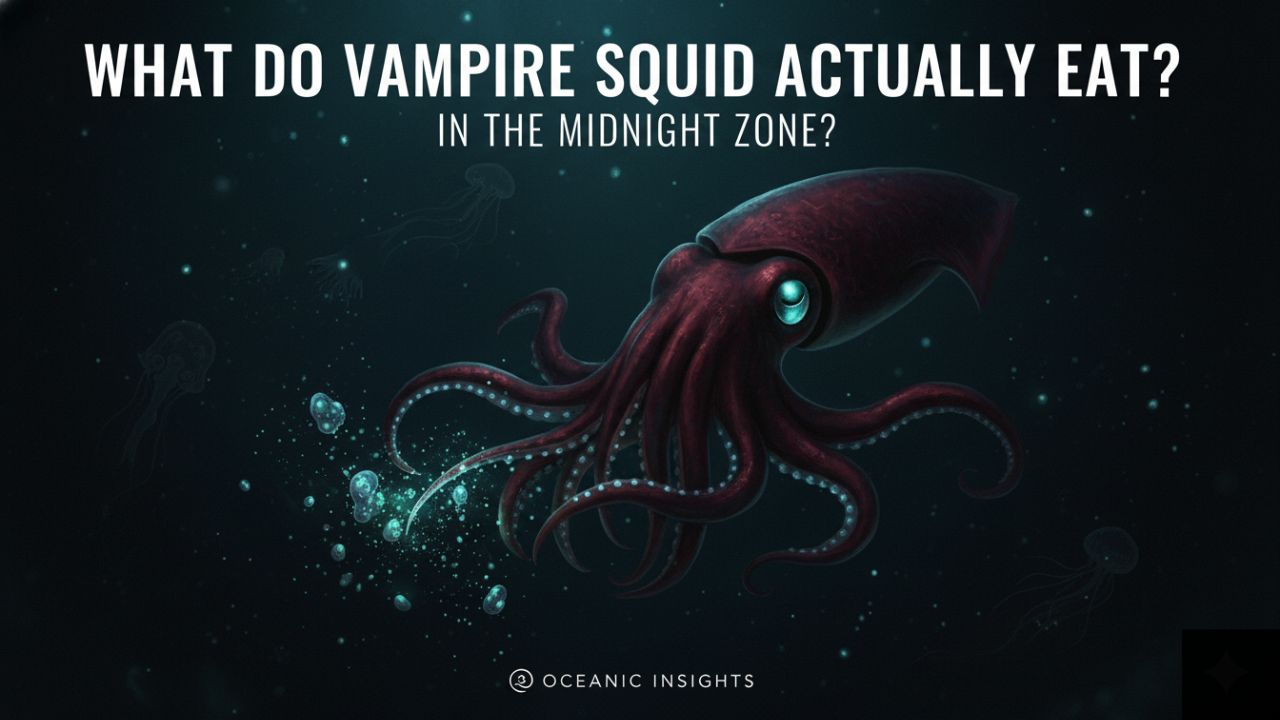
When you hear the name “vampire squid,” images of a blood-sucking deep-sea predator might come to mind. With its dark red body, enormous blue eyes, and cloak-like webbing stretching between eight arms, this creature certainly looks the part of an ocean nightmare. But what do vampire squid actually eat in the midnight zone? The answer is far less sinister—and far more fascinating—than you might imagine.
The Vampire Squid: Not Your Typical Predator
The vampire squid (Vampyroteuthis infernalis, literally meaning “vampire squid from hell”) lives in one of Earth’s most extreme environments: the midnight zone, also known as the bathypelagic zone. This pitch black region extends from roughly 3,000 to 13,000 feet below the ocean’s surface, where sunlight never penetrates and oxygen levels are barely sufficient to sustain life.
Despite its fearsome name and appearance, the vampire squid is actually a soft-bodied, passive creature about the size and shape of a football. Reaching a maximum length of only 12 inches, this small cephalopod is neither vampire nor squid it’s a living fossil, the sole surviving member of the order Vampyromorphida, representing an ancient lineage that bridges octopuses and squids.
The Surprising Answer: Marine Snow
So what do vampire squid actually eat in the midnight zone? Unlike their predatory cousins the octopuses and squids that hunt live prey vampire squids are detritivores, feeding exclusively on “marine snow.”
Marine snow is the continuous shower of organic debris that drifts down from the upper layers of the ocean to the seafloor. This peculiar food source consists of:
- Dead phytoplankton and zooplankton — Microscopic algae and animals that die in surface waters.
- Fecal pellets — Waste from small crustaceans like copepods and krill.
- Mucus nets — Discarded feeding structures from gelatinous animals called larvaceans.
- Crustacean remains — Bits of shells and body parts.
- Diatom fragments — Pieces of single-celled algae with silica shells.
- Organic aggregates — Clumps of various decomposing materials bound together.
While this diet might sound unappetizing to us, marine snow is remarkably abundant in the midnight zone and provides essential nutrients that would otherwise be scarce in this food-poor environment.
How Vampire Squids Capture Their Food
The feeding mechanism of vampire squids is unique among all cephalopods. Instead of tentacles used for grabbing prey, vampire squids possess two remarkable retractile filaments that can extend up to eight times the length of their bodies imagine fishing lines stretching 6 to 8 feet from a football sized animal.
These specialized filaments are covered with:
- Tiny sensory hairs that detect the slightest touch.
- A dense network of nerves making them extremely sensitive.
- Sticky mucus-producing cells that trap particles.
The Feeding Process
The vampire squid’s feeding behavior is methodical and energy-efficient:
- Drift and wait — The squid hovers motionless in the water, conserving energy.
- Extend the filament — One or both filaments are deployed like fishing lines.
- Capture particles — Marine snow sticks to the mucus-covered filament.
- Retrieve the catch — The squid slowly pulls the filament back toward its body.
- Scrape and collect — Using its eight arms, the squid scrapes accumulated particles off the filament.
- Create a food ball — Particles are combined with additional mucus from specialized cells on the arm suckers.
- Transfer to mouth — The mucus-coated food ball is moved to the squid’s mouth for consumption.
Scientists from the Monterey Bay Aquarium Research Institute (MBARI) made this groundbreaking discovery after analyzing 23 hours of remotely operated vehicle (ROV) footage and conducting laboratory experiments with live specimens. The footage revealed vampire squids drifting horizontally with filaments extended, accumulating particles, and even showed globs of marine snow and mucus dangling from their mouths.
Why This Diet Makes Sense in the Midnight Zone
What do vampire squid actually eat in the midnight zone, and why does this unusual diet work so well? The answer lies in the extreme environmental conditions and the squid’s remarkable adaptations.
Environmental Challenges
The midnight zone presents numerous survival challenges:
- Crushing pressure — At 3,500 feet depth, water pressure exceeds 1,500 pounds per square inch, equivalent to having a cow standing on every square inch of your body.
- Near-zero oxygen — Oxygen saturation can drop as low as 3%, levels that would be fatal to most marine life.
- Complete darkness — No sunlight penetrates this deep, making visual hunting impossible.
- Extreme cold — Temperatures hover between 39°F and 50°F (4-10°C).
- Scarce prey — Few animals can survive these conditions, making traditional hunting inefficient.
Perfect Adaptations
The vampire squid’s detritivorous lifestyle is perfectly suited to overcome these challenges:
Energy Conservation
- Neutral buoyancy eliminates the need to swim constantly to maintain depth.
- No energy wasted chasing elusive prey.
- Passive feeding through extended filaments.
- Reduced muscle mass compared to active predators.
Oxygen Efficiency
- Vampire squids are the only cephalopods capable of living permanently in oxygen minimum zones.
- Their metabolism is adapted to function at oxygen levels as low as 3% saturation.
- Minimal movement reduces oxygen demands.
Abundant Food Source
- Marine snow is plentiful in areas with productive surface waters above.
- Food literally falls to the squid rather than requiring active hunting.
- Continuous supply as organic matter constantly sinks from above.
Few Predators
- The hostile environment keeps most potential predators away.
- The vampire squid rarely needs to flee or fight.
- Bioluminescent defense mechanisms (glowing arm tips and luminescent mucus clouds) provide protection when needed.
The Journey of Marine Snow
To understand what vampire squid actually eat in the midnight zone, it’s essential to understand where marine snow comes from and how it reaches these depths.
Marine snow begins in the sunlit surface waters where phytoplankton conduct photosynthesis. As these microscopic plants and the animals that eat them die or produce waste, the material begins its descent. During this journey:
- Particles aggregate and grow larger.
- Smaller flakes clump together, some reaching several centimeters in diameter.
- Sinking rates accelerate as particles increase in size.
- The journey can take several weeks.
- Many particles are consumed by filter-feeders during descent.
- Only about 1% of surface production reaches the deep seafloor.
Scientists estimate that approximately 815 million tons of carbon reaches the ocean floor each year through marine snow, playing a crucial role in Earth’s carbon cycle and climate regulation.
Nutritional Content and Value
While marine snow might seem like a poor-quality food source, it contains significant nutritional value:
- Carbon — Essential for energy production.
- Nitrogen — Critical for building proteins.
- Phosphorus — Necessary for cellular processes.
- Organic compounds — Various nutrients from decomposing organisms.
- Microbial communities — Bacteria and other microorganisms that colonize the particles add additional nutrition.
The vampire squid’s extremely efficient lifestyle compensates for the relatively low nutritional density of marine snow. By minimizing energy expenditure, they can thrive on this abundant but modest food source.
Research Breakthroughs
The question “what do vampire squid actually eat in the midnight zone?” puzzled scientists for over a century. Since the first specimens were collected during the Valdivia Expedition (1898-1899), perhaps only a dozen scientific papers examined this mysterious creature, yet none could definitively identify its diet.
Earlier attempts to determine their diet faced significant challenges:
- Vampire squids are fragile and often injured during capture.
- Stomach contents analysis yielded inconclusive results.
- The animals couldn’t be kept alive long enough for observation.
- Their deep-sea habitat made direct observation nearly impossible.
The breakthrough came in 2012 when MBARI researchers Henk-Jan Hoving and Bruce Robison published their findings in the Proceedings of the Royal Society B. Their multi-faceted approach included:
- Video analysis — Reviewing decades of ROV footage
- Live specimen observation — Successfully maintaining vampire squids in laboratory aquaria for months
- Feeding experiments — Observing feeding behavior with marine snow particles
- Microscopic examination — Studying filament structure and function with optical and scanning electron microscopes
- Stomach content analysis — Examining preserved specimens from museum collections
The research revealed amorphous bits of broken-up organic debris in stomach contents, with no bones or intact prey remains that would indicate active predation.
Comparison with Other Deep-Sea Feeders
What do vampire squid actually eat in the midnight zone compared to their neighbors? While vampire squids feed on marine snow, other deep-sea creatures employ different strategies:
Filter Feeders
- Sea cucumbers and brittle stars extract particles from water or sediment
- Consume similar material but through different mechanisms
Scavengers
- Deep-sea crabs and amphipods feed on larger carcasses that sink from above
- Opportunistic feeders that locate food by smell
Active Predators
- Gulper eels and viperfish hunt small living prey
- Require more oxygen and energy than available in oxygen minimum zones
Ambush Predators
- Anglerfish use bioluminescent lures to attract prey
- Wait motionless to conserve energy between meals
The vampire squid’s detritivorous strategy is unique among cephalopods, representing a novel adaptation that allows permanent residence in the oxygen minimum zone where competitors and predators are virtually absent.
Misconceptions and Popular Culture
The vampire squid’s name has led to numerous misconceptions about what these animals actually consume. Common myths include:
Myth: Vampire squids suck blood Reality: They feed exclusively on non-living organic debris. The “vampire” name comes from their dark coloration and cloak-like webbing, not their feeding habits.
Myth: They’re aggressive predators Reality: Vampire squids are passive drifters that never hunt living prey.
Myth: They’re related to true squids Reality: They’re phylogenetic relics more closely related to octopuses, representing their own unique order.
Myth: They’re dangerous to humans Reality: These small, fragile creatures pose no threat whatsoever and inhabit depths humans rarely reach without specialized equipment.
Conservation and Ecological Importance
Understanding what vampire squid actually eat in the midnight zone helps us appreciate their ecological role. As specialized detritivores, they:
- Help recycle nutrients in the deep ocean
- Support the biological carbon pump that sequesters carbon in deep waters
- Serve as prey for deep-diving predators like whales, sea lions, and large deep-sea fish
- Indicate the health of surface water productivity through their abundance
Currently, vampire squids are not listed as endangered or threatened. However, they face emerging threats:
Microplastic Pollution Marine snow increasingly contains microplastic particles, which vampire squids inadvertently consume. These non-digestible particles may accumulate in their systems with unknown long-term effects.
Climate Change Changes in ocean temperature and chemistry could affect:
- Marine snow production and composition
- Oxygen minimum zone locations and extent
- Food availability in their habitat
Deep-Sea Mining Proposed mining operations in deep-sea environments could disturb the delicate ecosystems where vampire squids live.
The Bigger Picture: Marine Snow and Global Cycles
What vampire squid actually eat in the midnight zone connects to processes that affect the entire planet. Marine snow plays a crucial role in:
The Biological Carbon Pump
- Transports carbon from the atmosphere to deep ocean storage
- Helps regulate Earth’s climate
- Sequesters carbon for hundreds to thousands of years
Nutrient Cycling
- Returns nutrients from surface waters to the deep sea
- Eventually returns to surface through upwelling
- Supports global ocean productivity
Deep-Sea Food Webs
- Provides the primary energy source for midnight zone ecosystems
- Supports diverse communities that would otherwise not exist
- Connects surface and deep-sea ecological zones
Future Research Directions
Despite recent breakthroughs, many questions remain about vampire squid feeding ecology:
- How do they select which particles to consume?
- What is their growth rate on a marine snow diet?
- How do seasonal variations in surface productivity affect their feeding?
- What role does their gut microbiome play in digesting marine snow?
- How might climate change alter their food supply?
Advances in deep-sea observation technology, including improved ROVs, autonomous underwater vehicles, and extended laboratory maintenance capabilities, will help answer these questions in coming years.
Conclusion
So, what do vampire squid actually eat in the midnight zone? These remarkable creatures have evolved to thrive on marine snow—a continuous rain of dead organisms, feces, and organic debris falling from surface waters. This unusual diet, captured using specialized filaments up to eight times their body length, allows vampire squids to permanently inhabit the oxygen-starved midnight zone where few other animals can survive.
Far from being terrifying predators, vampire squids are gentle drifters perfectly adapted to one of Earth’s most extreme environments. Their feeding strategy represents a unique solution to the challenges of deep-sea life: minimal energy expenditure, abundant food supply, and few competitors or predators.
The discovery of their detritivorous lifestyle not only solved a century-old mystery but also revealed the remarkable diversity of survival strategies in the deep ocean. As we continue exploring Earth’s final frontier the deep seacreatures like the vampire squid remind us that nature’s creativity knows no bounds, and that even in the darkest, most inhospitable places, life finds ingenious ways to flourish.
Understanding what vampire squid actually eat in the midnight zone deepens our appreciation for the interconnectedness of ocean ecosystems and the crucial role that even the smallest particles of marine snow play in supporting life in the ocean’s depths and regulating our planet’s climate.
Leave a Reply