
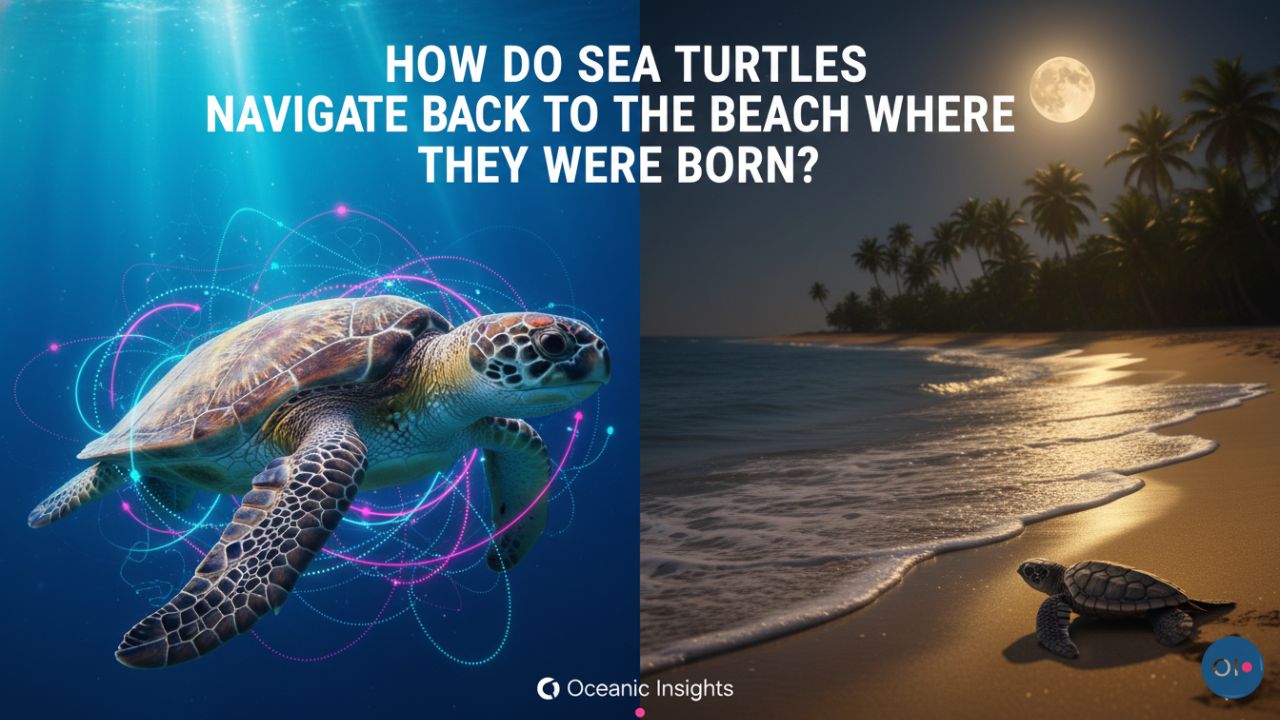
Imagine hatching from an egg buried in the sand, crawling to the ocean as a tiny hatchling weighing less than 50 grams, and then spending the next 10 to 30 years swimming thousands of miles across vast ocean expanses. Then, decades later, with no map, no GPS, and no guide, you somehow find your way back to the exact beach where you were born sometimes accurate to within a few hundred meters. This is exactly what sea turtles do, and scientists are still unraveling the mystery of how do sea turtles navigate back to the beach where they were born.
This remarkable ability, called natal homing, represents one of nature’s most extraordinary navigational feats. Female sea turtles undertake epic migrations across entire ocean basins before returning to nest in the same coastal area where they hatched decades earlier. Understanding how these ancient mariners accomplish this seemingly impossible task reveals a sophisticated navigation system that relies on multiple sensory cues, with Earth’s magnetic field playing the starring role.
The Phenomenon of Natal Homing in Sea Turtles
Natal homing is the behavior pattern in which animals migrate away from their geographic area of origin and then return to reproduce in the same location where they began life. While various species exhibit this behavior—including salmon, seabirds, and some mammals—sea turtles demonstrate one of the most impressive examples.
The journey begins when baby sea turtles emerge from their sandy nests, typically under the cover of darkness. After approximately 60 days of incubation, hatchlings break free from their eggs and dig their way to the surface in what biologists call “the hatchling frenzy.” These tiny creatures, measuring just a few inches long, scramble across the beach toward the ocean, guided initially by the lower, brighter seaward horizon.
Once in the water, hatchlings enter what’s known as the “swimming frenzy,” paddling frantically for 24 to 48 hours to reach offshore currents that will carry them to their oceanic nursery grounds. During these critical first hours and days of life, something remarkable happens: the tiny turtles are imprinting on multiple environmental cues, including the magnetic signature of the beach, chemical characteristics of the sand and water, and potentially visual landmarks.
Key Facts About Sea Turtle Natal Homing:
- Female sea turtles typically reach sexual maturity between 10 and 30 years of age, depending on the species
- Most species nest every 2 to 4 years once they reach maturity
- During a single nesting season, a female may lay multiple clutches of eggs (typically 3 to 7), spaced about two weeks apart
- Loggerhead sea turtles in the North Atlantic cover more than 9,000 miles round trip to lay eggs on North American shores
- The imprinted information from their first hours of life remains intact for decades, guiding adult turtles back to their birthplace
Earth’s Magnetic Field: The Primary Navigation System
The answer to how do sea turtles navigate back to the beach where they were born lies primarily in their remarkable ability to sense and use Earth’s magnetic field. This discovery has revolutionized our understanding of animal navigation and earned researchers recognition for some of the most creative work in marine biology.
Understanding Geomagnetic Imprinting
Loggerhead sea turtles can return to the beach where they were born using the Earth’s magnetic field as a guide. The process works because each part of the coastline has its own unique magnetic signature—a specific combination of magnetic field characteristics that distinguishes it from other locations.
Earth’s magnetic field varies across the planet’s surface in two key ways that sea turtles can detect:
Magnetic Inclination Angle: This is the angle at which magnetic field lines intersect the Earth’s surface. Along the east coast of North America, for example, because coastlines trend north-south while lines of constant inclination angle (called isoclinics) trend east-west, every area of coastline is marked by a different inclination angle.
Magnetic Field Intensity: The strength of the magnetic field also varies geographically. Lines of constant intensity (called isodynamics) also run approximately east-west in many geographic areas, meaning different coastal locations are marked by different field intensities.
Because Earth’s field changes over time, geomagnetic imprinting should cause turtles to change their nesting locations as magnetic signatures drift slightly along coastlines. This prediction was brilliantly confirmed by researchers who analyzed a 19-year database of loggerhead nesting sites in Florida, the largest sea turtle rookery in North America.
The Magnetic Field Evidence
Scientists conducted a groundbreaking study examining how sea turtles respond to slow changes in Earth’s magnetic field over time. Their findings provided some of the strongest evidence yet for geomagnetic imprinting:
Nesting density increased significantly in coastal areas where magnetic signatures of adjacent beach locations converged over time, whereas nesting density decreased in places where magnetic signatures diverged.
In simpler terms, when the magnetic field shifted so that the magnetic signatures from nearby beaches moved closer together, turtle nests became more densely concentrated in those areas. Conversely, in places where magnetic signatures spread apart, the nests became more spread out. This pattern precisely matched what scientists predicted would happen if turtles were using magnetic imprinting to find their natal beaches.
The study’s findings were remarkable not just for what they revealed, but for their creative approach. As one researcher noted, it represented a different way of measuring the importance of magnetic navigation by looking at population-level movement of turtles over time something that hadn’t been done before.
How Sea Turtles Detect Magnetic Fields: Two Separate Senses
Recent groundbreaking research has revealed that sea turtles don’t just have one magnetic sense they have two distinct systems for detecting Earth’s magnetic field, each serving a different navigational purpose.
The Tactile Magnetic Sense: Knowing “Where”
Baby sea turtles rely on a tactile magnetic sense likely driven by tiny magnetite crystals in their bodies to determine where they are on Earth’s magnetic map. This sense allows hatchlings to detect their location by feeling the magnetic field, similar to how we might feel texture or temperature.
The evidence for this tactile sense came from clever conditioning experiments. Researchers trained hatchling sea turtles to associate specific magnetic fields like those naturally found near the Turks and Caicos or Haiti with food rewards. The turtles would perform a conspicuous “dance,” lifting their heads and front flippers above the water when they expected to be fed.
To determine whether turtles were “seeing” or “feeling” the magnetic field, scientists used a brief, strong magnetic pulse. This pulse temporarily disrupts magnetite-based (tactile) sensing but doesn’t affect light-dependent magnetic sensing. The results showed that the pulse disrupted the turtles’ ability to recognize magnetic locations, confirming they use a tactile, magnetite-based system to read their magnetic map.
The Light-Dependent Magnetic Sense: Knowing “Which Way”
A separate, light-dependent magnetic sense acts more like a compass, helping the turtles keep a steady heading. This second system relies on light-sensitive molecules whose chemistry is subtly altered by Earth’s magnetic field, allowing turtles to determine which direction they’re facing.
How the Two Systems Work Together:
- Magnetic Map (Tactile Sense): Tells the turtle “You are here” by detecting the unique combination of magnetic field intensity and inclination angle
- Magnetic Compass (Light-Dependent Sense): Tells the turtle “This is north/south/east/west” to maintain a consistent heading
Together, these systems give the hatchlings the ability to both know where they are and which way to go before they ever leave sight of land. This dual-sense system explains how baby sea turtles, with no experience and no adults to guide them, can successfully navigate thousands of miles across open ocean.
The Critical Imprinting Period
The question of when and how sea turtles imprint on their natal beach has fascinated scientists for decades. The process of magnetic imprinting likely occurs within the first few hours or days of life. As hatchlings emerge from the sand and make their way to the sea, their brains encode the magnetic signature of that location.
What Happens During Imprinting:
During the hatchling’s journey from nest to ocean and their first 24 to 48 hours of swimming, they are registering multiple types of environmental information:
- The unique magnetic field intensity and inclination angle of their natal beach
- Chemical characteristics of the sand and surrounding water
- Potentially visual landmarks visible from the beach
- Wave patterns and directions near shore
This information creates what researchers call a multisensory memory. The combination of magnetic, chemical, and possibly visual cues forms an imprinted memory that guides their future journeys. The intensity and inclination of the magnetic field, in combination with chemical and visual cues, may create a multisensory memory that guides their future journeys.
Remarkably, this information remains dormant for decades through all the turtle’s years of oceanic wandering and growth until they reach sexual maturity. At that point, the imprinted information somehow activates, guiding the adult turtle back to its birthplace to continue the cycle.
Beyond Magnetism: Chemical and Olfactory Navigation
While Earth’s magnetic field provides the primary long-distance navigation system, sea turtles also use chemical cues, particularly as they get closer to their natal beaches. This multi-modal approach makes their navigation more accurate and reliable.
Detecting Waterborne and Airborne Chemicals
Sea turtles possess a remarkable ability that most marine animals lack: they can detect both waterborne chemicals (while submerged) and airborne odors (when they surface to breathe). Research has demonstrated that loggerhead turtles can detect airborne odorants associated with food, and more recently, scientists confirmed they can also detect odors from coastal mud and land.
Turtles exposed to air that had passed over a cup containing mud spent more time with their noses out of the water than did control turtles, demonstrating their sensitivity to land-based chemical cues. This ability might help sea turtles distinguish coastal areas from the open sea and detect their natal beaches from a distance.
The Dual-Cue Navigation Strategy
Scientists now believe sea turtles likely use a sequential navigation strategy similar to Pacific salmon:
Phase 1 – Open Ocean (Magnetic Navigation):
- Use magnetic field detection to navigate across vast ocean expanses
- Follow the magnetic “address” imprinted during their first days of life
- Navigate to the general coastal region where they were born
Phase 2 – Coastal Approach (Chemical Navigation):
- As they near the coast, switch to chemical cues for fine-tuning
- Detect the unique chemical composition of their natal beach or nearby vegetation to fine-tune their approach
- Use olfactory cues from the sand, microbial communities, or vegetation chemical signatures
This dual-cue strategy makes sense from an evolutionary perspective. Chemical cues from a specific beach dissipate rapidly with distance and are carried away by ocean currents, making them useful only at relatively short ranges (perhaps within a few dozen kilometers of shore). Magnetic cues, by contrast, provide reliable positional information across entire ocean basins but might not pinpoint a specific beach with perfect accuracy.
By using magnetic navigation for the long journey and chemical cues for the final approach, sea turtles can locate their natal beach with remarkable precision even after decades at sea.
Additional Navigation Cues
Beyond magnetic and chemical sensing, sea turtles employ several other navigation strategies that help guide their remarkable journeys.
Wave Direction and Patterns
Upon entering the ocean, hatchlings initially orient seaward by swimming into waves. Waves can be detected as orbital movements from underwater, providing a reliable directional cue when visual references are limited. Laboratory experiments have shown that turtles can transfer a course initiated based on wave direction to a course mediated by their magnetic compass, effectively calibrating their magnetic sense using wave information.
Visual Cues and Landmarks
While on the beach, hatchlings find the ocean by crawling toward the lower, brighter seaward horizon and away from the dark, elevated silhouettes of vegetation and dunes. Once mature and returning to nest, visual cues may help turtles identify specific nesting sites, particularly recognizable beach features or coastal landmarks.
However, artificial lighting from coastal development can severely disrupt this natural visual navigation, causing hatchlings to become disoriented and crawl toward lights instead of toward the ocean a major conservation concern.
Celestial Navigation
Some evidence suggests sea turtles may use celestial cues, particularly during nighttime navigation:
- Star patterns: Experiments indicate that some sea turtle hatchlings can use star patterns to orient themselves seaward after emerging from nests
- Moonlight: The brightness and position of the moon may help maintain directional consistency when other environmental cues are limited
Ocean Currents
Sea turtles are expert swimmers, but they also take advantage of major ocean current systems during their migrations. Understanding current patterns may be part of their inherited or learned navigational knowledge, helping them travel efficiently across ocean basins.
The Remarkable Accuracy of Sea Turtle Navigation
Just how accurate is the sea turtle navigation system? Research provides some impressive statistics:
Regional Accuracy: At certain nesting beaches in eastern Mexico where Kemp’s ridley turtles nest, researchers calculated that navigational errors from magnetic field drift over a decade would lead turtles to within an average of just 23 kilometers (14 miles) of their natal region. In some locations, navigational errors might be over 100 kilometers, but given that turtles are traveling thousands of miles, this still represents remarkable precision.
Beach-Level Precision: Studies of loggerhead populations show that turtles don’t just return to the same general coastal region—many return to nest within a few hundred meters of where they hatched. This level of precision suggests that additional cues beyond the magnetic map must be helping them pinpoint exact locations.
Feeding Ground Fidelity: Recent research has revealed that sea turtles show natal homing not just to breeding beaches but also to feeding grounds. Turtles hatched on specific beaches often end up at the same feeding areas, and genetic analysis shows that turtles from the same beaches share similar mitochondrial DNA haplotypes, distinguishing them from turtles born elsewhere.
Species-Specific Navigation Behaviors
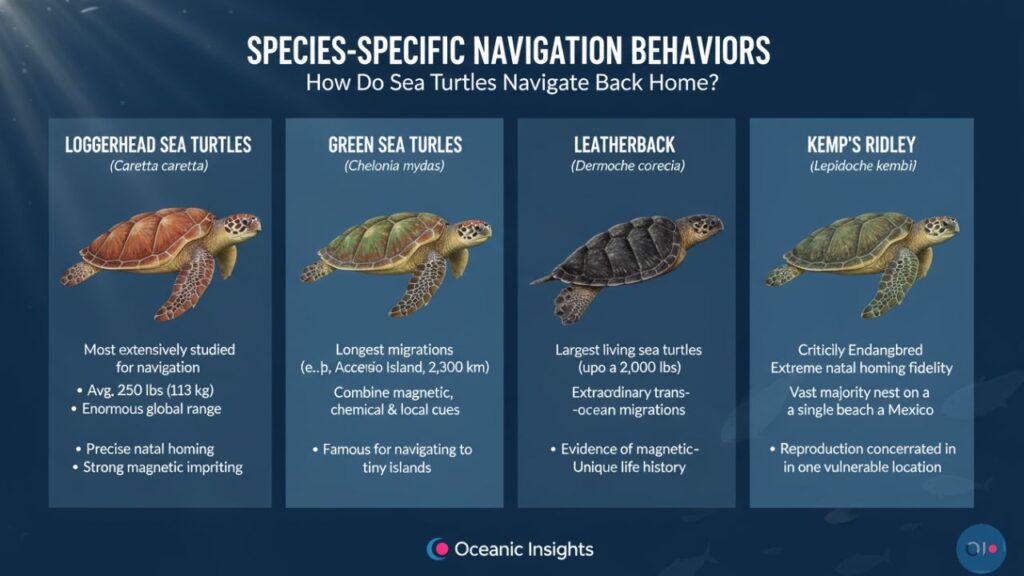
While the general principles of how do sea turtles navigate back to the beach where they were born apply across species, different sea turtle species show some variations:
Loggerhead Sea Turtles (Caretta caretta)
Loggerheads have been the most extensively studied species for navigation research. These turtles, which weigh about 250 pounds (113 kilograms) as adults, have an enormous range encompassing all but the most frigid waters of the world’s oceans. They demonstrate remarkably precise natal homing, with extensive data from Florida nesting beaches providing much of our understanding of magnetic imprinting.
Green Sea Turtles (Chelonia mydas)
Green sea turtles undertake some of the longest migrations of any sea turtle species. Famous populations include those that travel from Brazilian feeding grounds to Ascension Island in the mid-Atlantic—a journey of approximately 2,300 kilometers (1,400 miles) across open ocean to a tiny island target. Studies suggest green turtles also use magnetic cues combined with chemical and other local cues when approaching their nesting islands.
Leatherback Sea Turtles (Dermochelys coriacea)
The largest living sea turtles, leatherbacks can weigh up to 2,000 pounds and undertake extraordinary trans-oceanic migrations. While less studied than loggerheads, evidence suggests leatherbacks also use magnetic navigation, though their specific imprinting and homing behaviors may differ slightly due to their unique life history and habitat preferences.
Kemp’s Ridley (Lepidochelys kempii)
This critically endangered species demonstrates perhaps the most extreme natal homing fidelity. The vast majority of the world’s Kemp’s ridley population nests on a single beach in Mexico, suggesting exceptionally strong natal homing instincts that concentrate the entire species’ reproduction in one vulnerable location.
Conservation Implications
Understanding how do sea turtles navigate back to the beach where they were born has profound implications for conservation efforts. The reliance on magnetic and chemical cues makes sea turtles vulnerable to several human-caused disruptions:
Magnetic Pollution
Perhaps the most concerning threat is what scientists call magnetic pollution or electromagnetic noise. Human infrastructure produces artificial magnetic fields that can interfere with natural geomagnetic cues:
Sources of Magnetic Interference:
- Submarine cables carrying electrical current
- Offshore wind farms and power transmission lines
- Electrical grids and power stations near coastal areas
- Large metal structures and ships
If turtles rely on fine-scale magnetic gradients to find their nesting beaches, even small shifts could lead them astray. Understanding which cues matter most allows policymakers to design better rules regarding coastal development and electromagnetic infrastructure placement.
Light Pollution
Artificial lighting on nesting beaches disrupts the visual cues hatchlings use to find the ocean. Coastal development with unshielded lights can cause hatchlings to crawl inland toward lights instead of seaward toward the ocean, leading to dehydration, exhaustion, and death. Thousands of hatchlings die each year due to light pollution.
Conservation Solutions:
- Use turtle-friendly amber or red LED lights on coastal properties
- Shield lights to direct them downward rather than onto beaches
- Implement lighting ordinances during nesting season
- Educate coastal residents about proper lighting practices
Climate Change Effects
Rising global temperatures and changing ocean conditions affect sea turtle navigation in multiple ways:
Altered Ocean Currents: Climate change is shifting major current systems that turtles use during migration. These changes may alter traditional migration routes or make navigation more challenging.
Beach Erosion: Sea level rise and increased storm intensity cause erosion of nesting beaches. When a natal beach erodes away or changes dramatically, turtles may struggle to find suitable nesting sites in their imprinted area.
Shifting Magnetic Field: While Earth’s magnetic field changes naturally over time (a phenomenon called secular variation), the combination of natural changes and potential climate-related effects creates uncertainty about how future field changes might affect turtle navigation.
Temperature-Dependent Sex Determination: Sea turtle sex is determined by incubation temperature, with warmer temperatures producing more females. Climate change is skewing sex ratios in some populations, which could affect long-term population viability even if navigation remains intact.
Chemical Pollution
Runoff, oil spills, and other water pollution can alter the chemical cues in coastal waters that turtles use for final navigation to nesting beaches. Changes in the chemical signature of a beach area might make it harder for turtles to recognize their natal site.
Protecting Natural Navigation
Conservation strategies informed by navigation research include:
Beach Protection Programs:
- Preserve natural beach characteristics (sand quality, vegetation, chemical signatures)
- Minimize artificial alterations to nesting beaches
- Ensure hatchlings can imprint on their natal beach in a natural magnetic environment
Migration Corridor Conservation:
- Protect key marine areas along migration routes
- Reduce threats like fishing gear entanglement in migration corridors
- Monitor and minimize electromagnetic disturbances in important sea turtle habitats
Monitoring and Research:
- Continue long-term monitoring of nesting populations
- Track how nesting distributions change over time in response to environmental shifts
- Study whether conservation interventions (like relocating eggs) might disrupt magnetic imprinting
The Evolution of Sea Turtle Navigation
The sophisticated navigation abilities of sea turtles didn’t appear overnight. These systems evolved over millions of years, shaped by natural selection favoring turtles that could successfully return to favorable nesting sites.
Sea turtles have existed for over 100 million years, surviving the extinction event that killed the dinosaurs. Their navigation system has been refined across countless generations, with successful navigators passing on their genes while those that couldn’t find appropriate nesting sites left fewer offspring.
Evolutionary Advantages of Natal Homing:
Safety and Suitability: The only way a female turtle can be sure that she is nesting in a place favorable for egg development is to nest on the same beach where she hatched. If the turtle herself successfully hatched and survived to maturity, the beach must have provided suitable conditions for egg incubation and hatchling survival.
Genetic Adaptation: Populations nesting on different beaches show genetic differences, suggesting that over time, turtles become adapted to their specific natal areas. Returning to the same beaches maintains these local adaptations.
Navigational Reliability: Once turtles have successfully imprinted on and located their natal beach once, they can reliably return multiple times throughout their reproductive lives, ensuring continued reproductive success.
Interestingly, Earth’s magnetic field occasionally undergoes rapid changes called magnetic polarity reversals. Some scientists speculate that during these brief periods of rapid change, sea turtles might have had difficulty locating their natal beaches, potentially causing turtles to stray into new nesting areas. If they successfully bred in these new locations, subsequent generations could then reliably locate the new sites once the magnetic field stabilized potentially explaining how turtle populations colonized new regions over evolutionary time.
Technological and Scientific Applications
The study of how sea turtles navigate has inspired multiple areas of human technology and research:
Bio-Inspired Navigation Technology
Understanding how turtles detect and interpret magnetic fields has contributed to the development of novel navigation technologies. Engineers are exploring how to create compact, low-power magnetic sensors inspired by turtle magnetoreception for use in autonomous vehicles, drones, and spacecraft.
Quantum Biology
The light-dependent magnetic sense in turtles involves quantum mechanical effects in specialized molecules. This has opened new frontiers in quantum biology the study of quantum phenomena in living systems. Understanding how biological systems maintain quantum coherence at body temperature could revolutionize our understanding of physics and biology.
Neuroscience and Sensory Biology
Research on sea turtle navigation contributes to broader understanding of how nervous systems process sensory information, form memories, and generate complex behaviors. The ability of turtles to store imprinted information for decades and then act on it raises fascinating questions about long-term memory storage in the brain.
The Future of Sea Turtle Navigation Research
Despite tremendous progress, many questions remain about how do sea turtles navigate back to the beach where they were born:
Outstanding Research Questions:
- How exactly are magnetic field signatures encoded in the turtle brain during imprinting?
- What is the precise anatomical location and cellular structure of magnetoreceptors in turtles?
- How do the two different magnetic senses (tactile and light-dependent) interact neurologically?
- To what extent can turtles update or modify their magnetic maps based on later experience?
- How do turtles integrate information from multiple sensory modalities into unified navigational decisions?
- What happens to navigation ability as Earth’s magnetic field continues its natural drift over time?
Emerging Research Technologies:
Advanced tracking technologies are revolutionizing sea turtle research:
- Satellite tags provide long-term tracking data showing complete migration routes
- Biologging devices record environmental conditions experienced by turtles during migrations
- Genetic analysis reveals population structure and natal homing patterns
- Experimental electromagnetic coils allow scientists to precisely manipulate magnetic fields experienced by turtles in controlled settings
- Advanced brain imaging may soon reveal the neural circuits underlying magnetic sensing and navigation
Why This Matters: Conservation and Wonder
The question of how do sea turtles navigate back to the beach where they were born connects science, conservation, and human wonder at the natural world. These ancient mariners, unchanged in basic form for millions of years, accomplish navigational feats that challenge our understanding of perception, memory, and instinct.
Every sea turtle species is currently classified as either threatened or endangered. Understanding their navigation helps us protect them more effectively:
Conservation Success Stories:
- Protective lighting ordinances on nesting beaches have significantly reduced hatchling disorientation
- Marine protected areas along migration corridors provide safe passage
- Fishing gear modifications reduce bycatch
- Public education about sea turtles has built widespread support for conservation
The Broader Picture:
Sea turtles connect ocean ecosystems across vast distances. A turtle born on a Florida beach might spend decades foraging in the Caribbean, North Atlantic, or Mediterranean before returning to Florida to nest. Their migrations link marine and terrestrial ecosystems, transferring nutrients and energy across ecological boundaries.
Their ability to find their way home across thousands of miles of featureless ocean—using invisible magnetic fields, chemical traces, and other cues we’re still discovering—reminds us of the profound intelligence present in non-human animals. These creatures accomplish their navigational miracles with brains much smaller than ours, suggesting that intelligence and capability come in many forms beyond what we traditionally recognize.
Conclusion
The answer to how do sea turtles navigate back to the beach where they were born reveals one of nature’s most sophisticated navigation systems. Through a combination of magnetic field detection, chemical sensing, and other cues, sea turtles accomplish what seems impossible finding a specific beach after decades and thousands of miles at sea.
The primary mechanism involves geomagnetic imprinting: hatchlings encode the unique magnetic signature of their natal beach during their first hours of life, then use that magnetic “address” to navigate back as adults. Recent discoveries show that sea turtles possess two distinct magnetic senses a tactile sense that tells them where they are on Earth’s magnetic map, and a compass sense that tells them which direction to swim.
As sea turtles approach their natal coastlines, they likely switch to chemical navigation, detecting olfactory cues from their home beach. This multi-modal approach, combining magnetic, chemical, visual, and other sensory information, allows these remarkable reptiles to complete their life cycle with extraordinary precision.
Understanding this navigational prowess isn’t just scientifically fascinating it’s essential for conservation. By knowing which cues sea turtles rely on, we can better protect them from human-caused disruptions like light pollution, electromagnetic interference, and habitat destruction. The survival of these ancient mariners depends not only on protecting nesting beaches and ocean habitats but also on preserving the invisible magnetic and chemical signatures they use to find their way home.
The journey of a sea turtle from hatchling to ocean wanderer to nesting mother returning to her birthplace stands as a testament to the remarkable adaptations evolution can produce. These creatures prove that with the right sensory abilities and the wisdom encoded in millions of years of natural selection, navigation without maps or technology is not just possible but breathtakingly precise. Every sea turtle that successfully finds her natal beach represents a minor miracle—and a triumph of nature’s ingenious solutions to life’s challenges.
Leave a Reply