
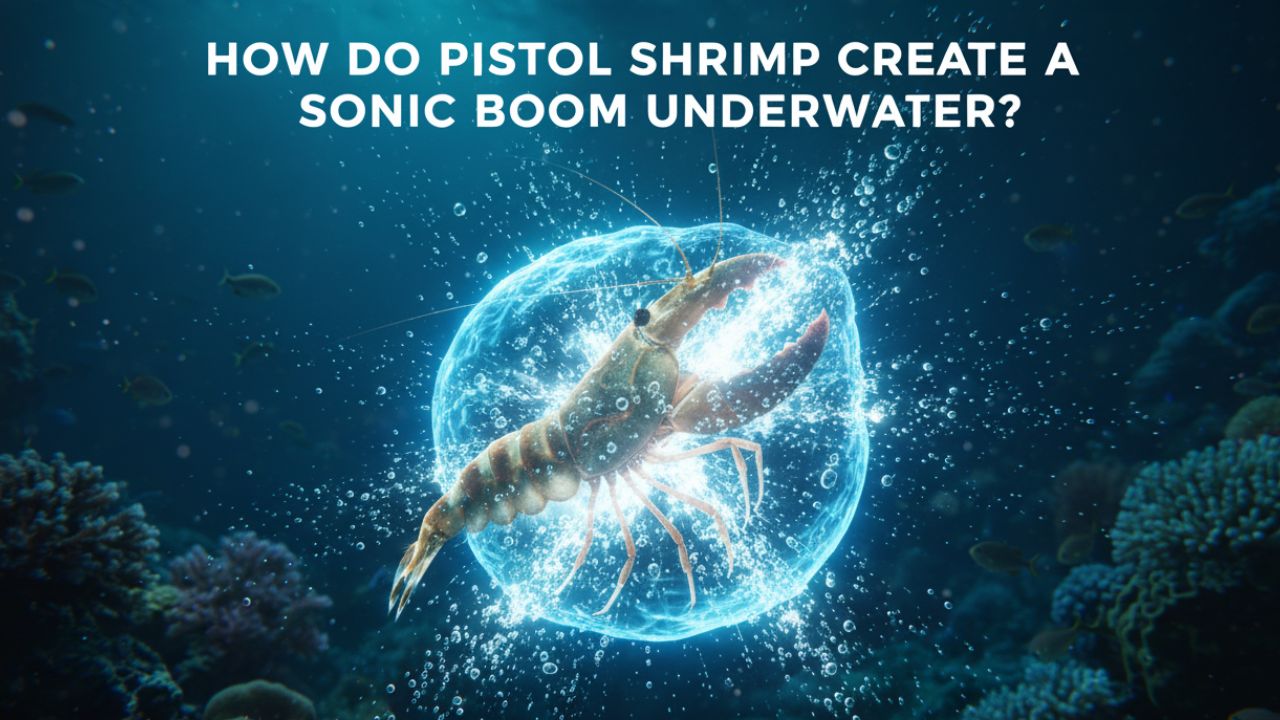
The ocean is filled with remarkable creatures, but few are as surprisingly powerful as the pistol shrimp. Despite measuring only 1-2 inches in length, these tiny crustaceans possess one of nature’s most impressive weapons. So, how do pistol shrimp create a sonic boom underwater? The answer lies in a fascinating combination of physics, biology, and extreme speed that produces one of the loudest sounds in the ocean.
The Anatomy of a Living Weapon
Pistol shrimp, also known as snapping shrimp or alpheid shrimp, belong to the family Alpheidae, which includes approximately 1,119 species across 38 or more genera. What sets these small marine creatures apart is their distinctly asymmetrical claws. While one claw remains normal-sized for typical tasks, the other grows to an enormous size often nearly the length of the shrimp’s entire body.
This oversized claw isn’t just for show. It’s a highly specialized hunting tool that operates on principles of physics that seem almost too powerful for such a small creature to harness. The claw features a unique socket-and-plunger mechanism that allows the pistol shrimp to generate extraordinary force when snapping it shut.
The Mechanics of the Snap
Understanding how do pistol shrimp create a sonic boom underwater requires examining the remarkable mechanics of their specialized claw. When a pistol shrimp prepares to strike, it opens its enlarged claw, cocking it like a gun. The process that follows happens with breathtaking speed.
The claw snaps shut in approximately 15 millionths of a second, creating a high-speed water jet that shoots out from the socket at speeds reaching 60 miles per hour (approximately 100 kilometers per hour). This isn’t just any water stream it’s a precisely directed pulse of liquid moving fast enough to dramatically alter the pressure dynamics of the surrounding water.
The rapid closure of the claw doesn’t produce the sound directly. Instead, something far more interesting happens: the high-speed water jet creates a phenomenon known as cavitation.
Cavitation: The Secret Behind the Boom
Cavitation is the key to understanding how do pistol shrimp create a sonic boom underwater. When liquid moves above a certain speed, the pressure within the liquid decreases according to Bernoulli’s principle. As the pistol shrimp’s water jet shoots forward at incredible velocity, the pressure drops so dramatically that it creates a low-pressure void essentially a vacuum bubble in the water.
This cavitation bubble doesn’t last long. As it moves forward along the jet’s axis, it forms a flat bowl-like structure called a cavitation ring. The surrounding water, responding to the extreme pressure difference, rushes in to fill the void. When the bubble finally collapses, or implodes, it releases an enormous amount of concentrated energy in an incredibly small space.
The implosion happens so violently that it creates several extraordinary effects:
- Extreme heat: The collapsing bubble generates temperatures exceeding 5,000 degrees Celsius, rivaling the surface temperature of the sun (approximately 5,500 degrees Celsius)
- Intense pressure: The pressure wave from the collapse can reach 80 kilopascals at distances of about 4 centimeters from the claw
- Sonic boom: The rapid compression produces a sound wave exceeding 200 decibels—louder than a gunshot
- Light emission: A phenomenon called sonoluminescence occurs, producing a brief flash of light
The entire sequence from claw snap to bubble collapse happens in approximately 300 microseconds less than a third of a millisecond.
Why Is It Called a Sonic Boom?
The term “sonic boom” typically refers to the shock wave created when an object breaks the sound barrier. While the pistol shrimp doesn’t travel faster than the speed of sound through water, the mechanism it creates produces similar effects.
When the cavitation bubble collapses, the water rushing to fill the void moves so rapidly that it generates a shock wave a sudden, violent pressure change that propagates through the water. This shock wave carries tremendous force despite originating from such a tiny source. The 200+ decibel sound produced is among the loudest biological sounds in the ocean, competing with much larger animals like sperm whales and beluga whales.
The Devastating Effects on Prey
How do pistol shrimp create a sonic boom underwater for hunting purposes? The answer reveals an efficient and brutal hunting strategy. When prey comes within striking distance typically within 3-4 centimeters of the claw the pistol shrimp fires its weapon.
The shock wave from the collapsing cavitation bubble is powerful enough to:
- Stun small fish and crustaceans
- Kill prey outright if they’re close enough
- Disorient larger animals that venture too near
The prey doesn’t need to be touched by the shrimp itself. The pressure wave alone does the work, allowing the pistol shrimp to hunt prey that would normally be too fast or too alert to catch with conventional methods. Once stunned or killed, the prey becomes an easy meal.
More Than Just a Weapon
Pistol shrimp use their sonic capabilities for more than hunting. These versatile creatures employ their cavitation-producing claws for several purposes:
Territorial Defense: Pistol shrimp will fire their claws at rivals and intruders, engaging in underwater duels to establish dominance. During these confrontations, shrimp may lose their claws, but they have the remarkable ability to regenerate them.
Burrow Construction: The force generated by their claw snaps is powerful enough to break apart rocks. Pistol shrimp use this ability to excavate burrows in hard substrate, including basalt stone, creating elaborate underground homes with multiple chambers and tunnels.
Communication: The snapping sounds serve as acoustic signals between shrimp, helping them communicate with colony members and potential mates.
The Phenomenon of Sonoluminescence
One of the most intriguing aspects of how do pistol shrimp create a sonic boom underwater is the production of light. When the cavitation bubble collapses, it briefly emits a flash of light a phenomenon known as sonoluminescence, or more specifically in this case, “shrimpoluminescence.”
The light flash has a broad spectrum and lasts for an extremely brief moment. It’s so quick that it’s invisible to the naked eye, lasting only about 100 nanoseconds. Scientists believe this light is a byproduct of the extreme temperatures and pressures generated during bubble collapse rather than serving any biological function for the shrimp.
The pistol shrimp was actually the first animal discovered to produce light through cavitation effects, making it a subject of significant scientific interest.
Living in Colonies: A Deafening Neighborhood
Pistol shrimp often live in large colonies on coral reefs, seagrass beds, and oyster reefs. When hundreds or thousands of these shrimp snap their claws simultaneously, the result is an underwater cacophony that has practical implications beyond the reef ecosystem.
The collective snapping of pistol shrimp colonies creates such intense background noise in shallow ocean waters that it can:
- Interfere with submarine sonar systems
- Disrupt underwater communication equipment
- Mask the sounds of larger marine animals
During World War II, the U.S. Navy actually recognized this phenomenon and used it strategically. Submarines would deliberately position themselves near pistol shrimp colonies or play recordings of shrimp snapping sounds to camouflage their presence from enemy sonar detection. The biological noise provided perfect acoustic cover for naval vessels trying to avoid detection.
Symbiotic Relationships
Despite their formidable weapons, pistol shrimp have developed fascinating cooperative relationships with other marine life. Many species form symbiotic partnerships with goby fish, creating one of the ocean’s most charming interspecies collaborations.
In these partnerships, the pistol shrimp does the hard work of building and maintaining an elaborate burrow system. The goby fish, which has superior eyesight compared to the nearly blind shrimp, serves as a lookout. When danger approaches, the goby signals the shrimp through characteristic tail movements, and both retreat into their shared burrow. The shrimp maintains contact with its partner by keeping its antennae on the goby while outside the burrow.
Some pistol shrimp species even exhibit eusocial behavior living in colonies with a queen and workers, similar to bees or ants. These colonial species can number over 300 individuals, all offspring of a single large female.
Scientific and Technological Applications
Understanding how do pistol shrimp create a sonic boom underwater has inspired scientists and engineers to explore practical applications of cavitation technology:
Medical Technology: Researchers are investigating whether controlled cavitation could be used for non-invasive medical procedures, including breaking up kidney stones and promoting tissue revascularization.
Water Purification: Scientists have proposed using cavitation generators that mimic pistol shrimp mechanics to create simple, handheld water filtration devices for developing nations.
Materials Science: The cavitation impact phenomenon is used in “cavitation peening,” a surface treatment process that improves the fatigue strength of metallic materials.
Energy Research: Some researchers have speculated about whether the extreme temperatures generated during cavitation collapse could potentially be harnessed as an energy source, though practical challenges remain.
The Physics That Makes It Possible
The remarkable ability of pistol shrimp to generate such extreme effects from such a small action comes down to the concentration of energy. While the shrimp’s muscles provide the initial force to snap the claw shut, the real power comes from the physics of cavitation.
The key principle is that a large amount of energy the kinetic energy of the fast-moving water jet gets compressed into an incredibly small space and time frame when the bubble collapses. This concentration of energy produces the extreme temperatures, pressures, and sound levels that make the pistol shrimp’s weapon so effective.
It’s similar to how a lightning bolt works: the electrical discharge superheats the air so quickly that it creates a low-pressure void, and when the surrounding air rushes back in to fill that void, it creates the thunder we hear. The pistol shrimp essentially creates miniature underwater thunderbolts.
Ecological Impact
Beyond their individual hunting prowess, pistol shrimp play important roles in marine ecosystems. Their snapping sounds contribute to the complex acoustic environment of coral reefs, and some marine animals use these sounds as navigation cues.
Gray whales, for instance, have been observed following the acoustic trails of pistol shrimp colonies. While the whales aren’t hunting the shrimp themselves, the shrimp colonies indicate the presence of rocky reef habitats that host the small crustaceans that whales feed upon.
The burrows created by pistol shrimp also provide shelter for various other small marine organisms, making them ecosystem engineers that help structure their habitats.
Conclusion
How do pistol shrimp create a sonic boom underwater? Through an extraordinary combination of specialized anatomy, extreme speed, and fundamental physics, these tiny creatures harness the power of cavitation to create one of nature’s most impressive weapons. By snapping their oversized claw at incredible speed, they generate a high-velocity water jet that creates a cavitation bubble. When this bubble collapses, it releases concentrated energy producing extreme heat, intense pressure, a loud sonic boom, and even a flash of light.
This remarkable ability allows pistol shrimp measuring just 1-2 inches to compete acoustically with 40-ton whales, stun fish without touching them, and dig through solid rock. The pistol shrimp’s cavitation weapon is a perfect example of how evolution can create surprisingly powerful solutions in unexpectedly small packages.
Whether viewed as a curiosity of nature, a subject of scientific study, or inspiration for human technology, the pistol shrimp’s sonic boom remains one of the most fascinating phenomena in the marine world a tiny gunslinger of the ocean depths that proves that size isn’t everything when it comes to making a big impact.
Leave a Reply