
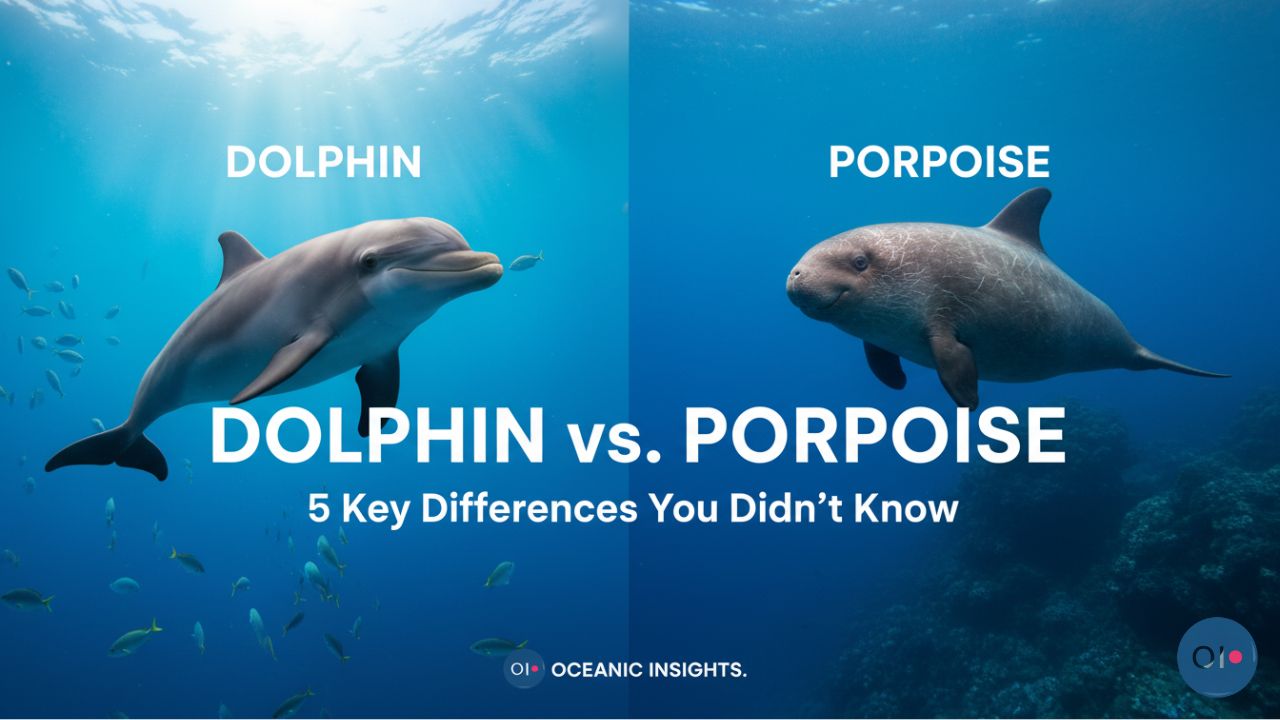
When you spot a sleek marine mammal leaping through ocean waves, do you know if you’re watching a dolphin or a porpoise? Most people use these terms interchangeably, assuming they’re looking at the same animal. However, the dolphin vs. porpoise debate reveals that these are actually two distinct groups of marine mammals with fascinating differences that go far beyond what meets the eye.
While both dolphins and porpoises belong to the order Cetacea and share many similarities including their intelligence, streamlined bodies, and aquatic lifestyle they are separate families with unique characteristics. Understanding the dolphin vs. porpoise distinctions not only helps you identify these remarkable creatures but also deepens your appreciation for the incredible diversity of marine life. Let’s dive into five key differences that most people don’t know about these captivating cetaceans.
Understanding the Basics: What Are Dolphins and Porpoises?
Before exploring the dolphin vs. porpoise differences, it’s essential to understand where these animals fit in the animal kingdom. Both dolphins and porpoises are cetaceans marine mammals that also include whales. More specifically, they’re both toothed whales (odontocetes), meaning they have teeth rather than baleen plates, use echolocation to navigate and hunt, and eat a carnivorous diet consisting primarily of fish and squid.
However, this is where their paths diverge. Dolphins belong to the family Delphinidae (oceanic dolphins), along with three other dolphin families. Scientists recognize approximately 40 dolphin species divided among these families. Porpoises, on the other hand, all belong to a single family called Phocoenidae, with only seven species identified worldwide.
The evolutionary relationship between these groups traces back approximately 50 million years to land-dwelling ancestors that gradually adapted to aquatic life. While dolphins and porpoises share a common ancestry, millions of years of evolution in different directions have created the distinct characteristics that separate them today.
Difference #1: Body Shape and Size That Set Them Apart
One of the most noticeable aspects of the dolphin vs. porpoise comparison involves their physical appearance, particularly their body shape and overall size.
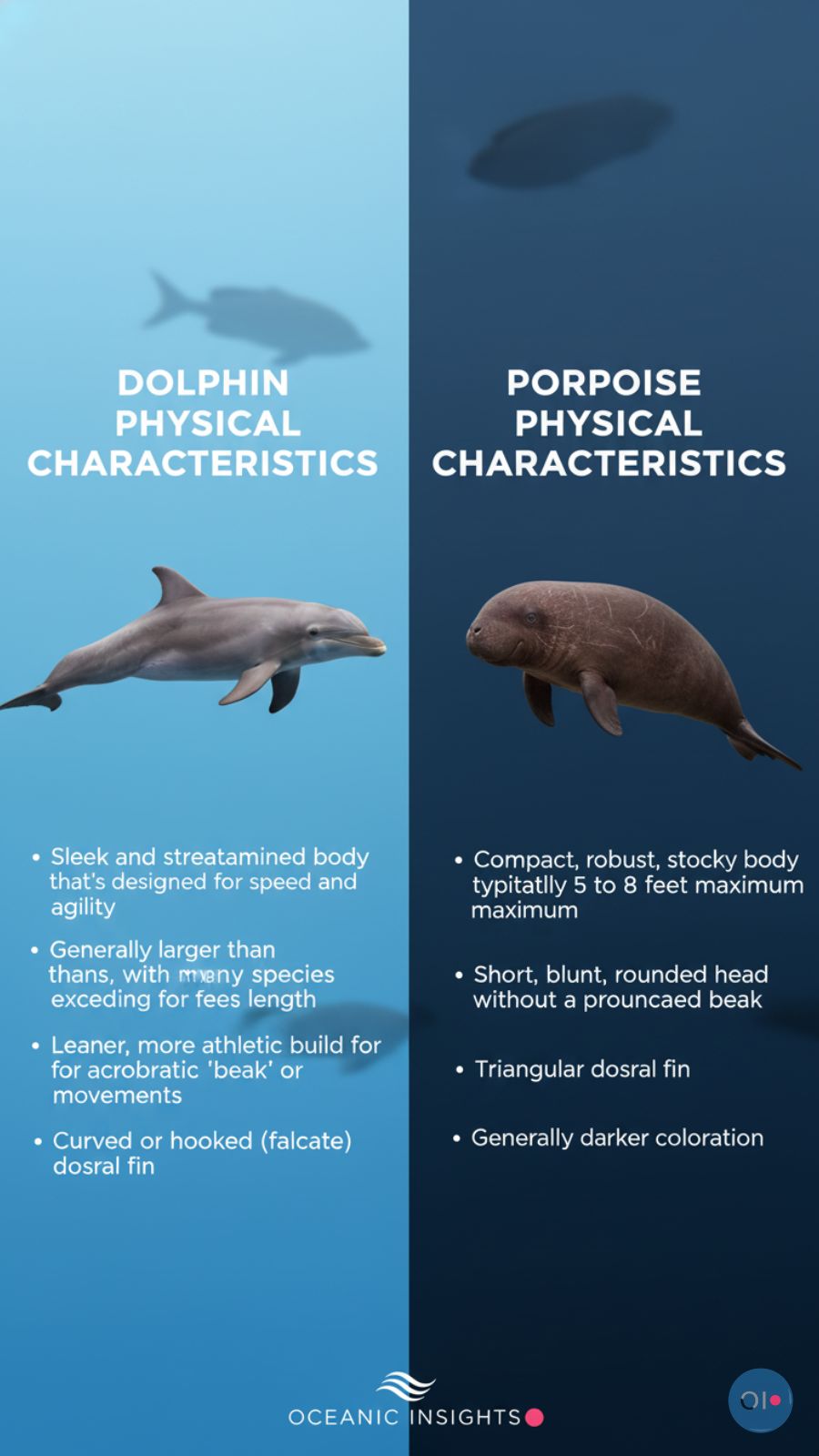
Dolphin Physical Characteristics:
- Sleek and streamlined body that’s designed for speed and agility
- Generally larger than porpoises, with many species exceeding 10 feet in length
- Leaner, more athletic build that allows for acrobatic movements
- Prominent elongated “beak” or rostrum extending from the face
- Curved or hooked dorsal fin that resembles a wave shape (called falcate)
The bottlenose dolphin, one of the most familiar species, typically measures 8 to 10 feet long. The orca, or killer whale—which is actually the largest member of the dolphin family can reach impressive lengths of up to 35 feet. Even smaller dolphin species like the Hector’s dolphin of New Zealand, which can be under 4 feet long, still maintain that characteristic sleek, streamlined appearance.
Porpoise Physical Characteristics:
- Compact, robust, stocky body that appears thicker and rounder
- Smaller overall size, typically ranging from 5 to 8 feet maximum
- Short, blunt, rounded head without a pronounced beak
- Triangular dorsal fin similar in shape to a shark’s fin
- Generally darker coloration compared to dolphins
The harbor porpoise, one of the most common species, usually measures only 5 to 6 feet long. This compact build gives porpoises a “portly” appearance that’s quite different from their leaner dolphin cousins. When comparing dolphin vs. porpoise side by side, the size and body shape differences become immediately apparent.
The head shape represents one of the easiest ways to distinguish between these animals. Dolphins feature an elongated beak that creates their famous grinning appearance, while porpoises have a more rounded, flat face. This difference isn’t just cosmetic it reflects different feeding strategies and ecological niches that these animals occupy.
Difference #2: Teeth Tell an Important Story
If you ever get close enough to examine a dolphin or porpoise (which would be extremely rare in the wild), their teeth provide a definitive way to tell them apart. The dolphin vs. porpoise tooth structure reveals fascinating adaptations to their respective lifestyles.
Dolphin Teeth:
- Cone-shaped teeth that resemble upside-down ice cream cones
- Needle-like and pointed structure
- Designed for grasping slippery prey like fish and squid
- Can number 100 or more teeth in some species
Dolphin teeth are shaped like cones, which helps them catch fish and other prey effectively. These pointed teeth aren’t designed for chewing dolphins swallow their food whole. Instead, the cone shape allows them to grasp and hold onto slippery fish, squid, and octopus before swallowing them headfirst.
Porpoise Teeth:
- Flat, spade-shaped teeth that look like tiny shovels
- Blunt edges rather than pointed tips
- More suited for smaller prey items
- Typically fewer teeth than dolphins
Porpoises have flatter, spade-shaped teeth that are uniquely adapted to their feeding habits. Despite these different tooth structures, both dolphins and porpoises hunt similar types of prey, including octopus, squid, and various fish species like herring.
The tooth shape difference reflects subtle variations in hunting techniques and preferred prey sizes. Dolphins with their cone-shaped teeth can tackle slightly larger or more active prey, while porpoises’ spade-shaped teeth are perfectly suited for the smaller fish and invertebrates that make up their diet.
Understanding these dental differences helps marine biologists identify stranded or deceased animals and provides insights into the dietary preferences and feeding ecology of different species. For the average ocean observer, however, you’d need to be unrealistically close to examine teeth making this more of an interesting fact than a practical identification tool.
Difference #3: Fins That Make Identification Easy
The dorsal fin that prominent fin on the back of these marine mammals provides one of the quickest and most reliable ways to distinguish dolphins from porpoises, even at a distance. This is particularly useful for whale watchers and marine enthusiasts trying to identify animals in the wild.
Dolphin Dorsal Fins:
- Curved or hooked shape (called falcate)
- Resembles a wave or backward-leaning curve
- Can be quite tall and prominent in some species
- Varies significantly among species, but generally maintains the curved appearance
- Develops unique notches and nicks over time that help identify individuals
The dolphin’s curved dorsal fin is one of their most recognizable features. Dolphins have hooked or curved dorsal fins that arch backward, creating a distinctive silhouette when they surface. Scientists who study dolphins often use these fins for photo identification, as each individual’s dorsal fin develops unique patterns of notches, nicks, and scars over their lifetime.
Porpoise Dorsal Fins:
- Triangular shape that’s more upright
- Similar to a shark’s dorsal fin in appearance
- Generally smaller and more compact than dolphin fins
- Symmetrical and straight-edged without the hook or curve
- Less likely to be visible when the animal surfaces
Porpoises have triangular dorsal fins that create a very different profile in the water. This shark-like fin shape is one of the most reliable field marks for identifying porpoises, especially when you can’t see the animal’s head or body clearly.
The difference in dorsal fin shape isn’t just aesthetic it relates to their swimming styles and behaviors. The dolphin’s curved fin provides stability during their fast, acrobatic swimming and leaping behaviors. The porpoise’s smaller, triangular fin suits their more reserved swimming style and less acrobatic lifestyle.
Both dolphins and porpoises also have pectoral fins (flippers) on their sides, and these contain bones similar to human arm bones and hands. The flippers contain the same number of bones as a human arm and end in five digits structured similarly to fingers, evidence of their land-dwelling ancestry from approximately 50 million years ago.
Difference #4: Communication and Social Behavior
One of the most surprising aspects of the dolphin vs. porpoise comparison involves how these animals communicate. While both species are highly intelligent, their vocal abilities and social structures differ dramatically.
Dolphin Communication:
- Produce distinctive whistles through their blowholes
- Create clicks for echolocation
- Make burst-pulse sounds during social interactions
- Each individual has a signature whistle that functions like a name
- Highly vocal animals that “talk” frequently
- Can whistle and click simultaneously
Dolphins make whistling sounds through their blowholes to communicate with one another underwater. These whistles are frequency-modulated, meaning the pitch changes over time, going up and down in distinctive patterns. Research has shown that each bottlenose dolphin develops a unique signature whistle during its first year of life, which it uses to broadcast its identity and location to other pod members.
Dolphins use different vocalizations in various situations when excited, playful, scared, or during courtship. They can even learn and imitate other dolphins’ whistles, possibly to get an individual’s attention within a large group. The social nature of these sounds is evident in how dolphins often respond to another dolphin’s whistle by whistling back or moving toward the vocalizing animal.
Porpoise Communication:
- Do not produce whistles like dolphins do
- Use only clicks for both echolocation and communication
- Produce narrow-band high-frequency (NBHF) clicks that are very high-pitched
- Much quieter and less vocal than dolphins
- Create distinctive “puffing” sounds when surfacing
Scientists are pretty sure that porpoises do not make whistles, possibly due to structural differences in the porpoise’s blowhole. Instead, porpoises rely on patterns of high-frequency clicks for communication. These clicks are so high-pitched that some researchers believe they evolved this way to avoid detection by killer whales, one of their primary predators.
Recent studies have revealed that harbor porpoises produce frequent high-repetition rate click series that appear to serve communicative functions, particularly during social interactions. However, porpoises remain much more acoustically “cryptic” than dolphins they’re simply not as talkative.
Cross-Species Communication:
Remarkably, a wild dolphin named Kylie in Scotland’s Firth of Clyde has been observed producing sounds similar to harbor porpoises rather than typical dolphin whistles. After 14 years without contact with other dolphins, Kylie apparently learned to communicate using porpoise-like clicks instead of dolphin whistles, demonstrating the remarkable vocal learning abilities of cetaceans.
Social Structure Differences:
Dolphins:
- Live in larger social groups called pods
- Pods can contain dozens or even hundreds of individuals
- Highly social and cooperative
- Known for playful interactions with each other and other species
- Often approach boats and humans out of curiosity
Porpoises:
- Typically found alone or in small groups of 2-4 individuals
- Much more shy and reserved around humans
- Less social than dolphins
- Avoid boats and human contact
- Rarely engage in the playful behaviors dolphins are famous for
The social behavior differences between dolphin vs. porpoise species reflect their different survival strategies. Dolphins rely on complex social cooperation for hunting, protection, and raising young, necessitating sophisticated communication systems. Porpoises, being more solitary and elusive, have less need for elaborate vocal repertoires.
Difference #5: Behavior and Personality in the Wild
Perhaps the most charming aspect of the dolphin vs. porpoise comparison involves their dramatically different personalities and behaviors. Anyone who has spent time watching these animals in the wild can attest to these behavioral differences.
Dolphin Behavior Characteristics:
Acrobatic and Playful:
- Frequently leap completely out of the water in spectacular displays
- Bow-ride on waves created by boats and ships
- Perform spins, flips, and tail slaps that appear playful
- Surf on ocean swells and waves near shore
- Approach swimmers and boats out of curiosity
- Engage in apparent play with seaweed, jellyfish, and other objects
Dolphins are the extroverts of the cetacean world. Dolphins are known for their playful behavior and often leap out of the water, creating those iconic images that have made them beloved worldwide. Their acrobatic displays aren’t just for show scientists believe these behaviors serve multiple purposes including communication, parasite removal, and possibly just plain fun.
Dolphins’ curiosity extends to humans. They frequently approach boats to ride the bow waves, seeming to enjoy the experience. Some populations of dolphins have been observed engaging in apparently cooperative behaviors with human fishermen, helping to drive fish toward nets in exchange for a share of the catch.
Highly Visible:
- Surface frequently and predictably
- Create noticeable splashes and disturbances
- Travel in visible, active groups
- Often found in both deep and shallow waters
- Comfortable in various water temperatures from tropical to temperate
Porpoise Behavior Characteristics:
Shy and Elusive:
- Rarely leap out of the water completely
- Stay below the surface most of the time
- Make subtle, rolling motions when surfacing to breathe
- Avoid boats and humans whenever possible
- Do not bow-ride like dolphins
- Much more difficult to observe in the wild
Porpoises are much shyer and usually stay below the surface, not engaging in the same playful behaviors as dolphins, making them harder to spot and study. When a porpoise surfaces to breathe, it typically makes a quick, rolling motion that barely disturbs the water, then disappears again. This subtle surfacing behavior contrasts sharply with dolphins’ splashy, attention-grabbing surface patterns.
Prefer Specific Habitats:
- Generally found in colder, deeper waters
- Stay closer to shore in some species
- More restricted in their habitat preferences
- Less adaptable to various water temperatures
- Often inhabit areas with strong currents
The behavioral differences between dolphin vs. porpoise species make dolphins far more commonly observed by tourists and researchers. Whale watching tours almost always feature dolphins rather than porpoises, simply because dolphins are more likely to be seen and to interact with boats. Porpoises, with their reserved nature, often go unnoticed even when they’re present in an area.
Why Do These Behavioral Differences Exist?
The contrasting personalities likely relate to different survival strategies. Dolphins’ social nature and playful behavior help strengthen pod bonds, facilitate cooperative hunting, and may even serve educational purposes for young dolphins learning complex hunting techniques.
Porpoises’ shy, elusive behavior might be an adaptation to avoid predators, particularly killer whales. Their high-frequency clicks are actually inaudible to killer whales, suggesting that staying quiet, staying hidden, and avoiding attention are key survival strategies for porpoises.
Why the Dolphin vs. Porpoise Distinction Matters
Understanding the differences between dolphins and porpoises isn’t just academic trivia it has real-world implications for marine conservation, research, and our relationship with the ocean.
Conservation Considerations:
Both dolphins and porpoises face serious threats in today’s oceans:
Shared Threats:
- Entanglement in fishing gear remains one of the biggest dangers, with many animals dying as bycatch
- Ship strikes injure and kill cetaceans, particularly in busy shipping lanes
- Ocean pollution, especially plastic debris, affects both groups
- Habitat loss from coastal development and ocean noise pollution
- Climate change altering food availability and ocean conditions
Dolphins and porpoises often mistake trash, like plastic bags, for food, which can lead to intestinal blockages and death. The vaquita, a small porpoise species found only in the Gulf of California, is now critically endangered with fewer than 10 individuals remaining, primarily due to bycatch in illegal fishing nets.
However, dolphins and porpoises require different conservation approaches due to their different behaviors and habitats. Porpoises, being more elusive and preferring colder waters, may be more vulnerable to certain threats that affect specific regions. Their smaller population sizes and less social nature may also make them slower to recover from population declines.
Research and Study:
The dolphin vs. porpoise behavioral differences significantly impact how scientists study these animals. Dolphins’ approachable nature and vocal behavior have made them the subject of extensive research on intelligence, communication, and social behavior. Much of what we know about cetacean cognition comes from dolphin studies.
Porpoises, being more elusive, remain less understood. Only recently have researchers begun to uncover details about porpoise communication and social structures using passive acoustic monitoring and sophisticated tracking technologies. Understanding both groups helps paint a more complete picture of cetacean evolution and marine ecosystem dynamics.
Educational Value:
Knowing the dolphin vs. porpoise differences enriches your experience when visiting the ocean. Being able to identify which animal you’re observing adds depth to the encounter and helps you appreciate the remarkable diversity of marine life. It also enables you to contribute to citizen science efforts many marine conservation organizations collect sighting reports from the public, but accurate identifications are crucial for this data to be useful.
Quick Reference Guide: Dolphin vs. Porpoise at a Glance
To help you remember the key differences, here’s a handy comparison:
DOLPHINS:
- Cone-shaped teeth
- Curved/hooked dorsal fin
- Elongated beak (rostrum)
- Larger size (6-12+ feet typically)
- Sleek, streamlined body
- Produce whistles and clicks
- Highly social (large pods)
- Playful and acrobatic
- Frequently leap from water
- Approach boats and humans
- 40+ species
PORPOISES:
- Spade-shaped teeth
- Triangular dorsal fin
- Rounded head, no beak
- Smaller size (5-8 feet maximum)
- Compact, stocky body
- Produce only clicks
- Less social (small groups or solitary)
- Shy and reserved
- Rarely leap from water
- Avoid boats and humans
- 7 species
Species You’re Most Likely to Encounter
Understanding dolphin vs. porpoise differences becomes more practical when you know which species you might actually see:
Common Dolphin Species:
Bottlenose Dolphin (Tursiops truncatus): The most familiar dolphin species, often seen in coastal waters worldwide. These are the dolphins commonly featured in aquariums and marine parks.
Common Dolphin (Delphinus delphis): Despite their name, they’re actually less commonly seen than bottlenose dolphins in many areas. They have distinctive hourglass patterns on their sides.
Spinner Dolphin (Stenella longirostris): Named for their spectacular spinning leaps, found in tropical waters worldwide.
Pacific White-Sided Dolphin (Lagenorhynchus obliquidens): Known for playful behavior and energetic displays, common in the North Pacific.
Orca/Killer Whale (Orcinus orca): Despite being called whales, orcas are actually the largest members of the dolphin family.
Common Porpoise Species:
Harbor Porpoise (Phocoena phocoena): The most widespread porpoise species, found in cold coastal waters of the North Atlantic and North Pacific. Small and elusive, often seen near shorelines.
Dall’s Porpoise (Phocoenoides dalli): Larger than other porpoises, with distinctive black and white coloring similar to orcas. Known for being one of the fastest cetaceans.
Vaquita (Phocoena sinus): Critically endangered, found only in the northern Gulf of California. The rarest marine mammal on Earth with fewer than 10 individuals remaining.
Finless Porpoise (Neophocaena phocaenoides): Unique among porpoises for lacking a dorsal fin, found in coastal waters of Asia.
The Odds Are in Your Favor: Why You’re More Likely to See Dolphins
If you’re hoping to spot cetaceans in the wild, you’re statistically much more likely to encounter dolphins than porpoises for several reasons related to the dolphin vs. porpoise behavioral differences:
Population and Distribution: With 40+ dolphin species compared to just 7 porpoise species, dolphins are simply more numerous and widespread globally. Dolphins inhabit tropical, temperate, and even some colder waters, while porpoises generally prefer colder environments.
Behavior and Visibility: Dolphins are social creatures that often come closer to boats, making them more visible to people, and their playful nature draws them to the surface. Porpoises’ preference for staying below the surface and avoiding human contact makes them much harder to observe.
Habitat Preferences: Many dolphin species thrive in the warm, accessible coastal waters popular with tourists and whale watching tours. Porpoises’ preference for colder, deeper waters or specific coastal regions means they inhabit fewer tourist-friendly locations.
Time of Activity: Dolphins are often active during the day, leaping, socializing, and hunting in visible ways. Porpoises can be active at any time but are often more active during dawn and dusk, times when fewer people are watching the ocean.
What to Do If You See a Stranded Dolphin or Porpoise
Occasionally, dolphins or porpoises become stranded on beaches. If you encounter a stranded cetacean:
- Keep your distance but note the animal’s location
- Call local marine mammal rescue or NOAA’s hotline immediately
- Do not attempt to push the animal back into the water
- Do not pour water over the blowhole (this can drown the animal)
- Keep dogs and crowds away from the animal
- Provide shade if possible and keep the animal moist (except the blowhole)
- Your accurate identification of whether it’s a dolphin or porpoise can help responders prepare appropriate equipment
Knowing the dolphin vs. porpoise differences can help you provide accurate information to rescue teams, potentially improving the animal’s chances of survival and release.
Conclusion: Celebrating Cetacean Diversity
The dolphin vs. porpoise comparison reveals two remarkably adapted groups of marine mammals that have evolved to thrive in different ways. While they share a common ancestry and many basic characteristics, millions of years of evolution have created distinct differences in their physical appearance, teeth structure, dorsal fins, communication abilities, and behaviors.
Dolphins, with their playful personalities, complex vocalizations, and acrobatic displays, have captured human imagination for millennia. Their intelligence and approachability have made them ambassadors for ocean conservation and subjects of extensive scientific study.
Porpoises, quieter and more reserved, represent equally fascinating adaptations to marine life. Their specialized high-frequency communication, compact bodies, and elusive nature showcase different strategies for surviving in the ocean’s challenging environment.
Understanding these differences enriches our appreciation for marine biodiversity and reminds us that the ocean contains far more complexity than we often realize. Both dolphins and porpoises face significant conservation challenges in our changing world, from entanglement in fishing gear to pollution and habitat loss. By learning to distinguish between these animals and sharing that knowledge, we can better support efforts to protect both groups and ensure these remarkable cetaceans continue gracing our oceans for generations to come.
Next time you spot a marine mammal breaking the surface, take a moment to observe carefully. Is that dorsal fin curved or triangular? Does the animal have a prominent beak or a rounded head? Is it leaping playfully or rolling subtly at the surface? Your enhanced understanding of dolphin vs. porpoise differences will transform a simple sighting into a meaningful connection with one of the ocean’s most captivating creatures.
Leave a Reply