
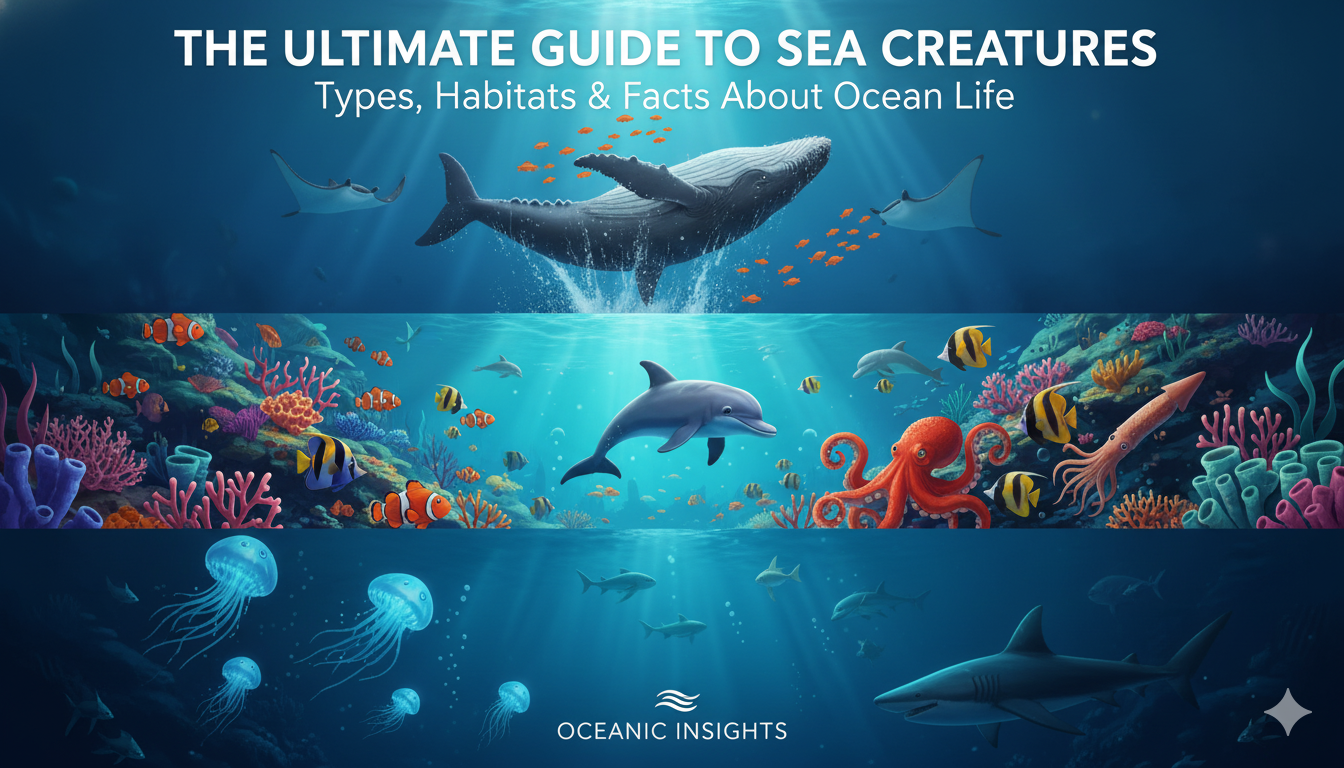
Covering over 70% of our planet, the ocean is a realm of immense beauty, power, and mystery. Within its depths resides a staggering array of life, from the smallest microscopic organisms to the largest animal that has ever lived. This guide will take you on a journey through the diverse habitats of the marine world, introducing you to the fascinating creatures that call it home and revealing some of the most intriguing facts about their existence.
A World of Water: Understanding Ocean Habitats
The marine environment is not a uniform expanse of water; it is a complex tapestry of interconnected habitats, each with its own unique characteristics and inhabitants. These habitats can be broadly categorized into coastal and open ocean environments, which are then further subdivided by factors like depth, light penetration, and topography.
Coastal Habitats: Where Land Meets Sea
The coastal zone, extending from the shoreline to the edge of the continental shelf, is a dynamic and highly productive area. Though it comprises only about seven percent of the total ocean area, it is home to the majority of marine life.
- Estuaries and Mangrove Forests: Estuaries are areas where freshwater from rivers and streams mixes with saltwater from the ocean, creating a unique and nutrient-rich environment. Mangrove forests, with their tangled root systems, thrive in these coastal areas and provide critical nursery grounds for many species of fish and invertebrates.
- Intertidal Zones: These are the areas closest to the shore, constantly being exposed and covered by the ocean’s tides. A diverse array of life thrives here, from scavenging creatures that feed on washed-up sea life to organisms that have adapted to the harsh, changing conditions.
- Coral Reefs: Often called the “rainforests of the sea,” shallow coral reefs are some of the most diverse ecosystems on Earth. They occupy less than 0.1% of the world’s ocean area yet provide a home for at least 25% of all marine species. These vibrant underwater cities are built by tiny animals called coral polyps, which secrete hard calcium carbonate exoskeletons. Fish, turtles, sharks, eels, crabs, and countless other creatures rely on reefs for shelter and food.
- Kelp Forests: These underwater forests, formed by large brown algae, are recognized as one of the most productive and dynamic ecosystems on Earth. They provide a unique three-dimensional habitat for a wide variety of invertebrates, fish, marine mammals, and birds. Sea otters, for instance, are a keystone species in many kelp forests, playing a crucial role in maintaining the health of the ecosystem by controlling sea urchin populations.
The Open Ocean: A Realm of Vastness and Depth
Beyond the continental shelf lies the vast open ocean, also known as the pelagic zone. This immense habitat is divided into several layers based on depth and the amount of sunlight that penetrates the water.
- The Sunlit Zone (Epipelagic Zone): This is the uppermost layer of the ocean, extending down to about 200 meters, where there is enough sunlight for photosynthesis to occur. This zone is teeming with life, from microscopic phytoplankton that form the base of the marine food web to large, fast-swimming predators like tuna and sharks.
- The Twilight Zone (Mesopelagic Zone): Extending from 200 to 1,000 meters, this zone has diminishing light. The creatures that inhabit this realm are adapted to low light conditions, with many possessing large eyes and the ability to produce their own light through bioluminescence.
- The Midnight Zone (Bathypelagic Zone): From 1,000 to 4,000 meters, this zone is in complete darkness. The animals here have evolved remarkable adaptations to survive in a world of high pressure and no sunlight.
- The Abyss (Abyssopelagic Zone): Extending from 4,000 meters to the seafloor, the abyssal zone is characterized by near-freezing temperatures and immense pressure.
- The Trenches (Hadalpelagic Zone): This is the deepest part of the ocean, found in oceanic trenches. Even in this extreme environment, life exists, primarily in the form of single-celled organisms.
A Parade of Marine Life: Types of Sea Creatures
The diversity of animal life in the ocean is truly astounding, spanning numerous phyla and exhibiting a wide range of adaptations. Marine animals can be broadly divided into vertebrates and invertebrates
Marine Invertebrates: The Spineless Majority
Invertebrates, animals without a backbone, make up the vast majority of life in the ocean.
- Mollusks: This diverse group includes snails, clams, and the highly intelligent cephalopods like octopuses, squids, and cuttlefish. The giant Pacific octopus, a master of camouflage, is often found hiding in kelp forests.
- Crustaceans: This group includes familiar creatures like crabs, lobsters, shrimp, and barnacles. The giant spider crab, found in the deep waters off the coast of Japan, is the largest known crab species, with a leg span that can reach 12 feet.
- Echinoderms: This phylum includes starfish, sea urchins, sea cucumbers, and brittle stars, all characterized by their spiny skin and radial symmetry.
- Cnidarians: This group includes jellyfish, sea anemones, and the corals that build the magnificent reef ecosystems. The clownfish has a fascinating symbiotic relationship with sea anemones, finding shelter among their venomous tentacles.
- Sponges: These simple, multicellular organisms are among the oldest animal groups and can be found in a variety of marine environments. Recent expeditions have even discovered new species of carnivorous sponges in the deep sea.
Marine Vertebrates: The Backbone of the Ocean
Vertebrates in the ocean are just as diverse as their spineless counterparts.
- Fish: With over 20,000 species, fish inhabit every corner of the ocean. They range from the tiny clownfish to the massive whale shark. In the deep sea, fish have evolved incredible adaptations to survive in the dark, high-pressure environment. The anglerfish, for example, uses a bioluminescent lure to attract prey in the inky blackness.
- Marine Mammals: This group includes whales, dolphins, porpoises, seals, sea lions, walruses, manatees, dugongs, sea otters, and polar bears. The blue whale is the largest animal on Earth, and its tongue alone can weigh more than an elephant. Dolphins are known for their intelligence and have a unique way of sleeping, resting only half of their brain at a time.
- Marine Reptiles: Sea turtles and sea snakes are the primary representatives of this group. All six species of sea turtles found in U.S. waters are protected under the Endangered Species Act.
- Seabirds: Birds like albatrosses and petrels spend a significant portion of their lives over the open ocean, while others like puffins and penguins are closely tied to marine environments for feeding.
Life in Extreme Environments: The Deep Sea and Polar Regions
The deep sea and the polar regions are two of the most extreme environments on Earth, yet they are home to a surprising abundance and diversity of life.
The Enigmatic Deep Sea
The deep sea is a world of perpetual darkness, crushing pressure, and frigid temperatures. The creatures that live here have evolved bizarre and fascinating adaptations to survive. Many are bioluminescent, producing their own light for communication, camouflage, and attracting prey. The barreleye fish has a transparent head and upward-facing eyes, allowing it to see silhouettes of prey above. Bone-eating worms, discovered in 2004, feed on the skeletons of dead whales that have fallen to the seafloor.
The Icy Realms of the Poles
The polar seas of the Arctic and Antarctic are characterized by extreme cold and seasonal sea ice. Despite these harsh conditions, these regions are teeming with life. The sea ice itself provides a crucial habitat for many organisms, from microscopic algae to large mammals.
- The Arctic: The Arctic is home to iconic species like the polar bear, which relies on sea ice to hunt seals. Other inhabitants include beluga whales, narwhals, walruses, and various species of seals.
- The Antarctic: The Southern Ocean is known for its vast populations of krill, which form the base of the food web for penguins, seals, and whales. The emperor penguin is a remarkable example of adaptation, breeding during the harsh Antarctic winter.
Fascinating Facts About Marine Life
- Ancient Lineage: Jellyfish have been around longer than the dinosaurs.
- Gender Bending: Clownfish are born male and can change their sex to female.
- Powerful Punch: The mantis shrimp can strike with the force of a .22 caliber bullet.
- No Stomach: Seahorses lack a stomach and must eat almost constantly to get the nutrients they need.
- Singing Whales: Humpback whales are known for their complex songs.
- Living Fossils: The chambered nautilus has survived for millions of years and can be found in the deep waters of the Western Pacific and Indian Oceans.
- Masters of Disguise: The spider crab covers itself with sponges and seaweed for camouflage.
- Sand Producers: The white sand on many tropical beaches is largely composed of the digested coral excreted by parrotfish.
The ocean is a world of wonders, and our understanding of its inhabitants and ecosystems is constantly evolving. From the vibrant coral reefs to the mysterious depths of the abyss, the diversity of life in the sea is a testament to the power of evolution and the interconnectedness of all living things. As we continue to explore this vast and vital realm, it is crucial that we also work to protect it for generations to come.
Leave a Reply